
Getting back to French after years without practice can feel intimidating. You might remember bits and pieces, but speaking or understanding feels rusty. The good news? Once you’ve learned French before, it returns faster than you think. Your brain still remembers patterns, sounds, and vocabular, it just needs to be reactivated.
In this guide, you’ll discover how to restart French online, build steady momentum, and regain confidence without overwhelm. Step by step, you’ll reconnect with the language and enjoy the process this time.

- Why relearning French feels different (and easier)
- 1. Restart with listening, not grammar books
- 2. Rebuild your speaking confidence
- 3. Review only the essentials (strategically)
- 4. Create a small, repeatable online routine
- 5. Immerse yourself online to make French part of your life again
- 6. Grow vocabulary in context
- 7. Accept mistakes, they are part of the process
- Relearning French online is easier than you think
Why relearning French feels different (and easier)
Many learners think starting again means going back to zero. In reality, you’re not a beginner anymore. You already built pathways in your memory, and although they may feel dusty, they’re there.
Moreover, adult learners usually have clearer motivation. Maybe you:
- Want to feel more confident using essential French phrases for travel during your next trip to France
- Plan to work with French clients
- Simply miss the language you once loved
Because your motivation is more intentional, progress often feels more meaningful. And when you’re learning online, you have flexibility, personalized tools, and constant exposure, advantages you might not have had before.
1. Restart with listening, not grammar books
Before jumping into exercises, wake up your ear. Online listening builds rhythm, vocabulary, and confidence without pressure.

Try 10–15 minutes daily:
- French podcasts suited to your level, with clear speech and topics you enjoy
- “slow” French news
- Netflix or YouTube with French audio + French subtitles
- short, simple videos instead of hour-long content
Don’t worry if you don’t understand everything at first. Your goal is contact, not perfection.
Tip: resist the urge to pause and translate every word. Let your brain reconnect naturally.
Additionally, mix passive and active activities. Listening is helpful, yet speaking and writing force your brain to retrieve information which accelerates relearning.
2. Rebuild your speaking confidence
Many learners understand French but freeze when speaking. After years without practice, hesitation is normal. However, speaking again is like warming up a muscle: awkward at first, smoother later.
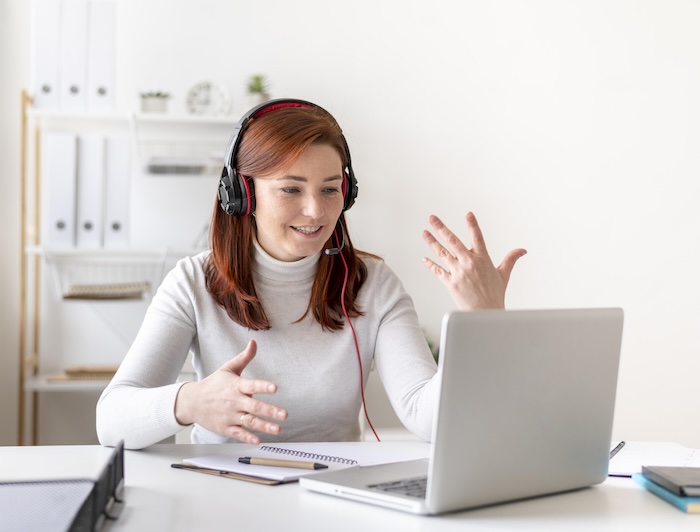
Here are simple ways to restart orally:
- repeat phrases aloud while listening
- record yourself saying short sentences
- join online conversation groups
- book short tutoring sessions
Gradually, your brain stops translating and starts thinking in French again. In addition, hearing yourself speak reduces fear. Soon, interactions will feel natural rather than stressful.
3. Review only the essentials (strategically)
In the meantime, you could reactivate your old knowledge. That way, your brain reconnects existing dots. You could focus on foundations that unlock everything else:
3.1 Core verbs
Start by revisiting common verbs such as être and avoir, followed by aller, faire and prendre. These will help you introduce yourself, describe your routine and talk about everyday activities
Rather than memorising conjugation tables alone, use each verb in a sentence about your own life: Je prends le train pour aller au travail or Je voudrais reprendre mes cours de français. Include a few reflexive verbs, such as se lever and se préparer, to describe your daily routine.
3.2 Simples tenses
Start with the present tense so you can talk about your habits, preferences and current situation. Practise describing a typical day aloud or writing a few sentences about what you usually do at the weekend.
Once you feel more comfortable, revisit the passé composé to describe completed past events and the futur proche to explain your plans. For example: Hier, j’ai retrouvé une amie. Demain, je vais travailler à la maison. If you previously studied the imparfait, gradually bring it back to describe past habits and situations.
3.3 Articles and gender
When reviewing vocabulary, learn each noun with its article: un voyage, une question, le travail, la maison. This helps you remember its gender and makes it easier to choose the right adjective or pronoun later.
Refresh the difference between indefinite articles (un, une, des) and definite articles (le, la, l’, les). Practise them in short sentences, such as J’ai un chat. Le chat s’appelle Félix. You can also revisit du, de la and de l’ through everyday expressions like boire du café or écouter de la musique.
3.4 Everyday and time connectors
Simple linking words help you move beyond short, separate sentences. Revisit mais, parce que and donc to contrast ideas, give reasons and explain results: Je comprends assez bien le français, mais je cherche encore mes mots.
Time expressions are useful too. Review the difference between depuis, il y a and pendant to talk more clearly about when things happened and how long they lasted. Compare J’ai commencé le français il y a dix ans with J’habite ici depuis deux ans and J’ai étudié le français pendant trois ans. Use examples from your own life to make these distinctions easier to remember.
Ready to Get Back into French?
If you’re returning to French after a long break, I’d be happy to help you refresh your knowledge and rebuild your confidence with private online lessons tailored to your needs.
4. Create a small, repeatable online routine
Progress doesn’t happen by accident. Therefore, build a routine that fits your life instead of fighting it. Try this balanced weekly rhythm:
- 3 short sessions for vocabulary or grammar
- 2 listening activities (podcast, video, series)
- 1 or 2 speaking moment (with a private tutor if possible to get instant feedback)
- 1 review day to consolidate
Because the plan is flexible, you can adapt it when life gets busy. More importantly, routines signal to your brain: this matters. Over time, learning becomes automatic.
5. Immerse yourself online to make French part of your life again
Relearning French online doesn’t have to feel like studying in a classroom. In fact, the key is to make it enjoyable and relevant.

You can blend French into your daily life in simple ways:
- Switch your phone settings to French: many of my students find this a quick and effective habit.
- Follow French creators on Instagram or YouTube: this adds authentic exposure and helps you choose the right online French lessons for your level.
- Cook with French recipes: it’s a fun, hands-on way to learn food-related vocabulary.
- Read short news articles or blogs designed for learners: practice reading in manageable chunks.
- Select the right online course for you: one that matches your goals, pace, and interests will keep you motivated longer.
The more French connects to your hobbies, routines, and passions, the easier it is to retain and use in real life.
6. Grow vocabulary in context
When you return to French, some words may look familiar but remain difficult to recall in conversation. Instead of reviewing isolated vocabulary, notice how words are used in phrases, dialogues and short stories. For example, learning prendre rendez-vous as a complete expression gives you something you can immediately use.
Choose a few useful expressions from what you read or hear, then reuse them the same day in a short paragraph or voice recording. Return to them regularly, using a notebook or spaced-repetition app if helpful, and practise saying them aloud as well as recognising them.
7. Accept mistakes, they are part of the process
It can be frustrating to forget a familiar word or struggle with something you once found easy. Give yourself time to retrieve what you learned. A hesitant conversation can still be a useful opportunity to practise, and mistakes can help you identify what needs revisiting.
When you feel stuck, try rephrasing your idea with simpler words. When listening, replay a short passage and notice what becomes clearer the second time. These small steps give you practical ways to keep going without expecting perfect French.
To stay motivated when learning French, set manageable goals and notice specific improvements: understanding more of a podcast, recalling an expression or speaking with less preparation. Focus on what you can do now and what you would like to do next.
7.1 What NOT to do when relearning French online
Avoid these common traps:
- jumping straight into advanced material
- studying intensely for one week, then quitting
- comparing yourself to your past level
- focusing only on grammar exercises
- waiting until you feel “ready” to speak
Slow, steady, real-world practice always wins.
7.2 When online tutoring speeds things up
Studying independently is a useful way to reconnect with French, but you may find it difficult to identify what needs attention or decide what to practise next. A tutor can help you assess what you remember, revisit gaps in your knowledge and choose activities that match your current level and goals.
In my private online French lessons, we can work on pronunciation, refresh grammar through practical examples and make time for conversation. You’ll have support when you get stuck, feedback to help you improve and regular opportunities to put familiar words back into use. Even one session every two weeks on Zoom can make a noticeable difference.

Relearning French online is easier than you think
You’re not starting from zero, you’re reactivating knowledge that’s already in your brain. Every previous effort still counts, and even small, consistent steps make a big difference.
Whether your goal is travel, work, culture, or simply the joy of speaking again, French is ready to come back into your life. With the right approach, motivation, and daily practice, your fluency will return faster than you expect.


