
How to Make French Adjectives Agree and Place Them Correctly
If you’ve ever paused while trying to choose between grand and grande or beau and belle, you’re not alone. French adjectives must agree with the nouns they describe and be placed correctly in the sentence, which can seem tricky at first. They change according to the gender and number of the noun and may appear either before or after it.
But once you understand the rules of agreement and placement, everything starts to click. Whether you’re studying for a French exam or just want to engage with locals in France, this guide will help you to:
-
Make adjectives agree in gender and number
-
Form feminine and plural adjectives
-
Recognize irregular adjectives
-
Place adjectives before or after nouns correctly
-
Use tips to sound more natural in French

1. Basic Rules: Masculine, Feminine, Singular, Plural
In French, adjectives agree with the noun. They must match gender (masculine/feminine) and number (singular/plural):
- un petit chat — a small cat (masculine singular)
- une petite maison — a small house (feminine singular)
- des petits chats — small cats (masculine plural)
- des petites maisons — small houses (feminine plural)
But unfortunately, it’s not that simple as we love rules and their exceptions in French !
1.1. Forming the Feminine
Firstly, most adjectives simply add -e for feminine:
-
grand (m) → grande (f) (tall)
-
petit → petite (small)
-
noir → noire (black)
Note that the endings “-s”, “-d”, and “-t” are silent in the masculine form but pronounced in the feminine, due to the presence of the “e”.
For example :
– François est blond et intelligent
– Françoise est blonde et intelligente.
Want to master these subtle pronunciation rules and sound more like a native? Check out this helpful guide: Tips to Improve Your French Pronunciation Skills.
Adjectives already ending in -e stay the same :
-
rouge → rouge (red)
-
triste → triste (sad)
- jeune → jeune (young)
1.2. Forming the Plural
Now, adjectives must also match number: singular or plural. If the noun is plural, make the adjective plural too. The basic change is adding -s for plural in both genders.
-
grand → grands
-
grande → grandes
Adjectives ending in -s or -x stay the same:
-
il est heureux → ils sont heureux
- il est gris → ils sont gris
For the feminine plural, we generally combine the rules as follows :
- grand → grande → grandes
- petit → petite → petites
2. Irregular Forms of Adjectives
2.1 Feminine Irregular Adjectives
Some adjectives add a doubled letter before the feminine “e”:
| Masculin | Féminin | Exemple |
|---|---|---|
| australien | australienne | Il est australien → Elle est australienne |
| ponctuel | ponctuelle | Il est ponctuel → Elle est ponctuelle |
Other adjectives change their endings following a pattern. These are challenging to keep in mind and are one of the typical mistakes in French:
| Masculin | Féminin | Règle / Exemple |
|---|---|---|
| sportif | sportive | -if → -ive |
| sérieux | sérieuse | -eux → -euse |
| rêveur | rêveuse | -eur → -euse |
| calculateur | calculatrice | -teur → -trice |
| étranger | étrangère | -er → -ère |
| discret | discrète | -et → -ète |
2.2 Plural Irregular Adjectives
Please keep in mind that «-al »/«-au » generally become «-aux » :
| Masculin singulier | Pluriel | Exemple |
|---|---|---|
| beau | beaux | Pierre est beau → Pierre et Kevin sont beaux |
| original | originaux | Il est original → Ils sont originaux |
| sentimental | sentimentaux | Il est sentimental → Ils sont sentimentaux |
And once more, with a few exceptions like:
- banal/banals (ordinary)
- fatal/fatals (critical)
- naval/navals (naval)
- final/finals (final)
The plural feminine form is regular: “ale” changes to “ales” :
- Elle est originale. Elles sont originales.
- Elle est sentimentale. Elles sont sentimentales.
2.3 Adjectives of color

French is full of color idioms, many of which are vivid and fun. Adjectives of color follow the same rules as normal adjectives with two exceptions :
- If the color word comes from a noun (fruit, object, material, etc.), generally it does not change:
-
- une jupe orange / des jupes orange (orange skirts)
- un sac marron / des sacs marron (brown bags)
- Furthermore, when a color is made of two words (or hyphenated), it normally stays the same such as :
- une veste bleue / des vestes bleu clair (pale blue jackets)
- une maison verte / des maisons vert foncé (dark green houses)
2.4 Irregular Adjectives
We have “special” masculine forms before a masculine singular noun starting with a vowel or silent h :
| Adjective | Masculine (before consonant) | Masculine (before vowel/silent h) | Feminine | Masculine plural | Feminine plural |
|---|---|---|---|---|---|
| beau | beau | bel | belle | beaux | belles |
| nouveau | nouveau | nouvel | nouvelle | nouveaux | nouvelles |
| vieux | vieux | vieil | vieille | vieux | vieilles |
| fou | fou | fol | folle | fous | folles |
| mou (soft) | mou | mol | molle | mous | molles |
Here are a few quick examples so you can see the difference :
- un nouveau bâtiment → un nouvel appartement
- un vieux monsieur → un vieil homme
- un beau jardin → un bel arbre
3. Where Do Adjectives Go?
3.1 After the Noun
Most descriptive adjectives follow the noun. Use this position for colors, shapes, nationalities, and detailed descriptions :
-
un chat roux— a ginger cat
- un livre français — a french book
-
une idée fantastique — a fantastic idea
And you can use multiple adjectives after the noun. When you do, keep the order natural: inherent quality (size/shape) then color then other descriptors:
- une petite table ronde en bois — a small round wooden table
3.2 The BRAGS Rule: Adjectives That Come Before the Noun
BRAGS stands for:
-
Beauty — beau, joli
- Range – premier, deuxième, troisième
-
Age — jeune, vieux, nouveau
-
Goodness — bon, mauvais, meilleur, gentil
-
Size — grand, petit, long, gros, bref
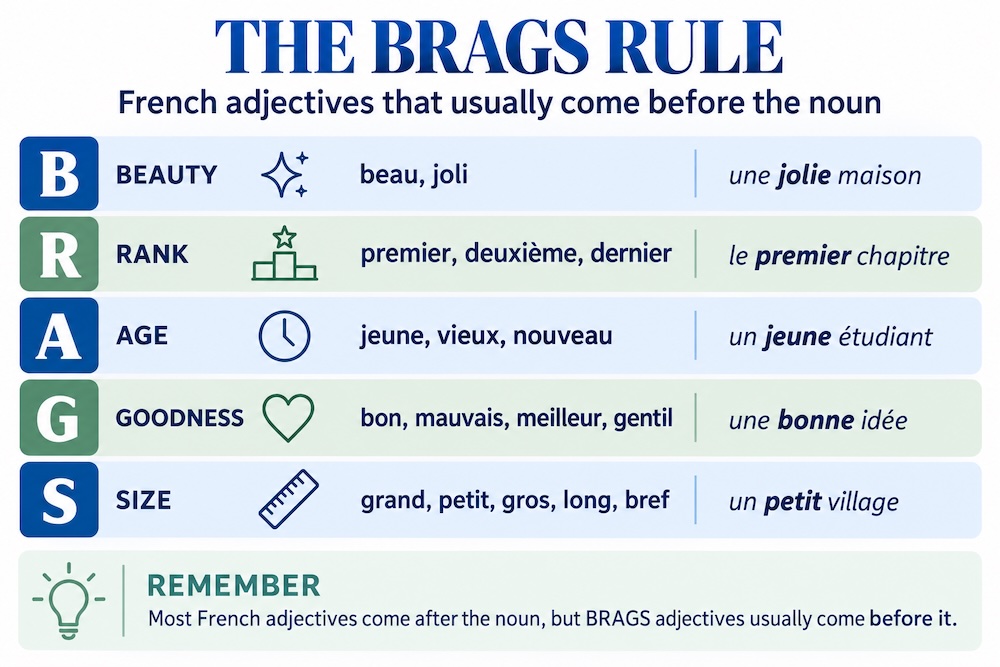
Remember to agree these adjectives with the noun:
- un bon plat → une bonne glace
- un petit chat → une petite tortue
3.3 Adjectives That Change Meaning Depending on Placement
Some adjectives change meaning when you move them. Position affects sense and emphasis. Key examples are:
| Adjective | Before the noun | After the noun | Examples |
|---|---|---|---|
| ancien | former | old / elderly | un ancien professeur — a former teacher • un professeur ancien — an elderly teacher |
| grand | great / remarkable | tall | une grande femme — a remarkable woman • une femme grande — a tall woman |
| propre | own | clean | ma propre chambre — my own room • une chambre propre — a clean room |
| cher | dear (emotionally) | expensive | mon cher ami — my dear friend • un ami cher — an expensive friend |
More adjectives such as “curieux” (curious or strange) “seule” (unique or alone), “pauvre” (poor or sad) also follows this rule.
Understanding nuance is essential, similar to how false friends work in French.
4. Frequently Asked Questions about French Adjectives
Q: Where do adjectives go?
A: Most adjectives come after the noun they describe. For example: “une maison blanche” (a white house).
A few common and short adjectives usually go before the noun. These include words for Beauty, Age, Rank, Goodness, and Size.
Q: Does word order change the meaning sometimes?
A: Yes — some adjectives shift meaning depending on position, for instance :
un seul professeur (a unique teacher) vs. un professeur seul (a teacher alone)
Q: Are there irregular adjectives?
A: Yes — some change forms a lot. For example :
beau / bel / belle, nouveau / nouvel / nouvelle, vieux / vieil / vieille,..
Q: How do you make an adjective feminine?
A: Add -e to make many masculine adjectives feminine. Example: “petit” → “petite”.
Change other endings as needed: -f becomes -ve (sportif → sportive), -x becomes -se (heureux → heureuse), and irregulars exist (beau → belle).
Q: How do you make an adjective plural?
A: Add -s to the feminine singular form to make feminine plural. Example: “intelligente” → “intelligentes”.
To truly master French adjective spelling and agreement rules, many native speakers rely on le Bescherelle — the gold-standard reference for French grammar and usage.
Practice Tips and Final Thoughts
French adjectives may seem complex, but regular practice and the BRAGS rule make them easier over time.
-
Read texts and identify adjective agreements
-
Rewrite sentences: un chat noir → une chatte noire → des chats noirs
-
Speak aloud to internalize patterns
-
Work with a tutor for personalized feedback
Eager to advance your French ? Schedule private French tutoring sessions for tailored exercises and feedback on adjective agreement.