
How Do I Know My French Level? A1 to C2 Explained
If you are learning French, you may have wondered: What is my French level? Perhaps you can read a little French but find it difficult to communicate with locals. You may manage in restaurants and hotels yet struggle to understand French speakers at a natural speed. Knowing your current level can help you choose suitable resources, set realistic goals, describe your abilities on a CV or select the right French exam.
This guide explains the French CEFR levels from A1 to C2 and helps you assess your listening, speaking, reading and writing so you can identify the next stage of your French learning journey.
If you would like personalised guidance, my private online French lessons can help you identify your strengths and follow a learning plan adapted to your goals.

1. How to Assess Your French Level
To assess your French level accurately, you need to consider what you can understand and communicate in real situations. Knowing grammar rules or recognising vocabulary in a multiple-choice test provides useful information, but it does not give a complete picture of your ability.
Consider All Your French Skills
The Common European Framework of Reference (CEFR) considers several language activities:
- listening;
- reading;
- spoken interaction;
- spoken production;
- writing.
Your level may not be identical in every skill. For example, you might understand a B2-level newspaper article but feel closer to B1 when speaking spontaneously. Instead of asking only, What is my overall French level?, consider these more precise questions:
- What can I understand when French is spoken at a natural speed?
- Can I participate in a conversation without preparing every sentence?
- What types of texts can I read comfortably?
- Can I write a clear message, email or structured argument?
- Can I adapt my French to social and professional situations?
Use Self-Assessment, Tests and Personal Feedback
A French level test can give you an approximate result, particularly for grammar, vocabulary, listening and reading. However, short online tests do not always evaluate speaking and writing, so their result should be treated as a useful indication rather than a complete assessment.
You can obtain a clearer picture by combining:
- a CEFR self-assessment grid;
- an online placement test;
- examples of your spoken and written French;
- feedback from a qualified French teacher;
- an official exam if you need formal proof of your level.
2. French CEFR Levels from A1 to C2
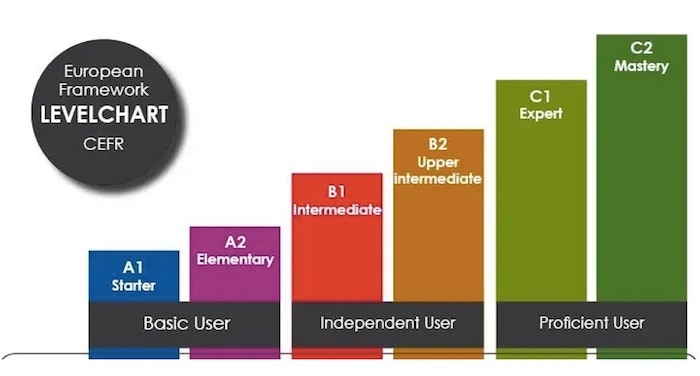
The French CEFR levels provide a common scale for describing language ability. The six main levels are grouped into three broad categories:
- Basic user: A1 and A2
- Independent user: B1 and B2
- Proficient user: C1 and C2
The following summary will help you identify the description that corresponds most closely to your current abilities.
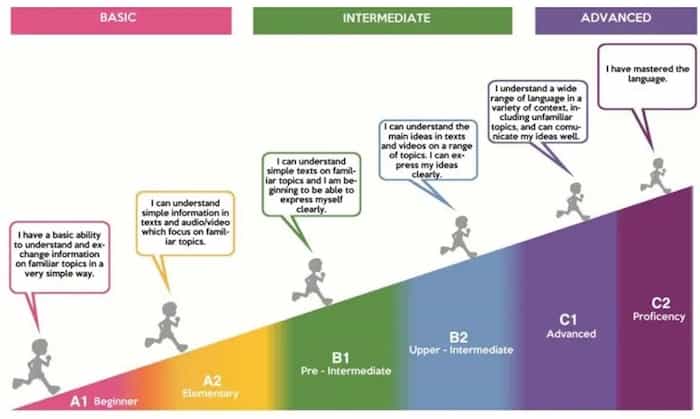
| French level | General ability | Examples of what you can usually do |
|---|---|---|
| A1 | Beginner | Introduce yourself, answer very simple questions and manage basic exchanges |
| A2 | Elementary | Communicate in familiar daily situations and understand common expressions |
| B1 | Intermediate | Handle most travel situations and discuss familiar subjects |
| B2 | Upper intermediate | Interact with relative spontaneity and explain opinions in detail |
| C1 | Advanced | Communicate fluently and effectively about complex subjects |
| C2 | Proficient | Understand almost everything and express subtle distinctions precisely |
A1 French Level : Beginner
At A1 French level, you can understand and use familiar everyday expressions when people speak slowly and clearly. This level can help you manage a few essential situations while travelling in France, although you will still need support for longer or less predictable conversations.
You can usually:
- introduce yourself and provide basic personal information;
- answer questions such as What is your name?, Where do you live? and What is your job?;
- order a coffee or a croissant;
- understand simple signs, menus and short messages;
- interact in a basic way when the other person is prepared to help.
At this stage, pronunciation and listening deserve particular attention. These tips for improving your French pronunciation can help you recognise and reproduce unfamiliar sounds.
A2 French Level: Elementary
At A2 French level, you can communicate about familiar subjects and complete simple everyday tasks. You have acquired useful vocabulary and can get basic things done in French, but unfamiliar topics and fast speech may still cause difficulties.
You can usually:
- order in a restaurant and book a hotel room;
- talk about your family, work, routine and immediate environment;
- ask for and understand simple information;
- communicate during familiar and predictable exchanges;
- understand the main message in short, clearly delivered announcements.
However, you may struggle to follow a detailed guided tour, understand a professional meeting or follow discussions between colleagues. If you use French at work, my quick guide to Business French introduces useful vocabulary and common professional situations.
B1 French Level: Intermediate
At B1 French level, you become an independent user. You can manage most situations that arise while travelling in a French-speaking country and take part in conversations about familiar subjects.
You can usually
- Understand anything that is said clearly and refers to pretty standard terms (work, education, interests, etc).
- Travel through a French speaking country should be easy and elementary
- Successfully communicate about familiar topics and things you are passionate about
- Describe events, experiences, goals and provide arguments to explain your ideas.
You may still need people to repeat or rephrase when conversations become fast, idiomatic or highly specialised.
B2 French Level: Upper Intermediate
At B2 French level, you can interact with French speakers with a good degree of fluency and spontaneity. Travelling, reading French websites and communicating with locals should feel considerably easier, although you may still lack vocabulary in specialised areas
This is the level that is recommended for high-skilled professions working in France : engineers, architects, managers, scientists, doctors, lawyers,..
You can :
- Understand the essential content of any abstract or practical communication, even in a complex text
- Communicate in a spontaneous way. You can work in French and there will be not hiccups in your communication with French locals
- Express yourself in a clear and detailed way on a wide range of topics.
- Give your opinion on current affairs and outline the drawbacks and advantages of doing anything.

C1 French Level: Advanced
At C1 French level, you can use the language flexibly and effectively in social, academic and professional contexts. You can express yourself fluently without frequently searching for words and can organise complex ideas clearly.
You can :
- Understand a large variety of complex and long texts. You can grasp implicit meanings
- Use of French is flexible in many areas of your life (personal, professional, social)
- Speak about complex topics in a well-structured way. You have excellent control over how you organise and articulate your speech
- Express yourself spontaneously and fluently.
C2 French Level: Proficient
At C2 French level, you can understand virtually everything you hear or read and express yourself with precision, fluency and nuance. You can reformulate ideas from different sources and distinguish subtle shades of meaning, even in complex situations.
C2 represents a very high level of proficiency, but it does not automatically mean that you are bilingual or that your French is identical to that of a native speaker. A highly proficient learner can still have an accent, encounter unfamiliar cultural references or continue developing specialist vocabulary.

Not Sure Which French Level Describes You?
During personalised one-to-one lessons, we can identify your strengths, the areas that need more attention and the most useful next steps for your goals.
3. Why it is important to know your level ?
Knowing why your French level matters will help you turn a broad ambition such as I want to become fluent into a realistic and personalised plan.
Choose Suitable Lessons and Learning Goals
Unless you have reached the Holy Grail, the ‘near bilingual’ level, you will always have room to improve. However, how can you progress if you don’t know where you’re starting from?
The main reason to know your French level is that you’ll know how much you need to progress. And, more importantly, your private tutor will have a better idea about the curriculum he or she needs to create for you.
A beginner in French doesn’t have the same learning needs as someone with an advanced level. If I’m aware of your level, I will be able to work with you on your weaknesses and the skills we need to focus on.

Describe Your French Level on a CV
Writing your French level on a CV can create a real dilemma. Is it better to say ‘beginner’ (I don’t want to lower my abilities) or ‘intermediate’ (I need the job, after all!) level of French? Should you separate the 4 skills as well (listening, reading, writing, and speaking) or group them in 2 groups?
The main thing I could tell you is don’t lie on your resume ! If the job implies a good level of French and you barely know how to use ‘être’ and ‘avoir’, then just write ‘beginner’. This way, you will avoid a potentially embarrassing situation during the interview.
If you are applying for a French-speaking position, my guide to preparing for a French interview provide additional practical advice.

Recognize your progress
Your CEFR level is not only useful for courses, applications and exams. It can also help you recognise how far you have come. Progress is sometimes difficult to notice from one week to the next, particularly at intermediate and advanced levels.
Compare what you can do now with what you found difficult several months ago. Perhaps you can follow longer conversations, write without translating every sentence or express an opinion with more precision. These changes are meaningful signs of progress, even before you officially move from one CEFR level to the next.

4. Which French Test or Exam Can Confirm Your Level?
A French test or exam can provide either an approximate placement result or formal proof of your language proficiency. The right option depends on why you need to know your level.
Online French Level Tests
An online test is useful if you want a quick indication of your current ability. Some tests assess only grammar, vocabulary, reading or listening, so remember that the result may not reflect your spoken and written French.
You can use the official CEFR self-assessment grid or explore the level-based exercises and test available through RFI’s Français Facile. These resources can help you identify a likely range before seeking a more complete assessment.
Official French Qualifications
If you need recognised proof of your French level for work, study or an administrative procedure, you may need an official diploma or test. Common qualifications include:
- DILF: initial proficiency, below or around the first CEFR level;
- DELF: separate diplomas for A1, A2, B1 and B2;
- DALF: separate diplomas for C1 and C2;
- TCF: a test that places your ability on the CEFR scale;
- TEF: a test used for several academic, professional and immigration-related purposes.
The appropriate exam and required level depend on your objective and the organisation requesting proof. Requirements can change, so always check the current official instructions before registering. If you are working towards a qualification, these tips for preparing for a French exam will help you organise your studies, practise the different skills and feel more confident on exam day.

5. How Long Does It Take to Reach the Next French Level?
The time required to reach the next French level varies considerably. There is no universal number of study hours because every learner has a different background, schedule and objective.
Your progress mainly depends on:
- your current French level;
- how regularly you practise;
- your exposure to spoken and written French;
- the time you spend reviewing between lessons;
- your previous language-learning experience;
- your motivation and personal goals.
Progress is not always linear. You may improve quickly at first and then need more time as the language becomes increasingly complex. This does not mean that you have stopped progressing. Understanding more, speaking with less hesitation and expressing your ideas more accurately are all meaningful signs of improvement.
Would you like help identifying your strengths and creating a personalised learning plan? Tell me about your current French, your goals and the situations in which you want to communicate.
Comments are closed.