
The French subjunctive explained : Rules and Usage Guide
Updated 18th December 2025
The French subjunctive, or le subjonctif, is an important part of French grammar that you will encounter often. It expresses feelings, wishes, doubts, and other subjective ideas. Unlike the future or the past tenses there is no real equivalent in English so it is usually translated using the indicative form.
You will notice that many verbs in the subjunctive mood are irregular and sometimes tricky to pronounce. Also, some verbs switch between the indicative and subjunctive depending on whether the sentence is positive or negative. With practice and focused lessons, you can learn to use the French subjunctive confidently, even though many native speakers still find it challenging.

1. How to conjugate the subjunctive
When you form the present subjunctive in French, the process is similar for most verbs. You begin with the third person plural (ils/elles) form of the verb in the present tense. From there, you remove the ending -ent to get the stem. Then, you add the subjunctive endings.
The subjunctive endings you add are the same for most verbs:
-e, -es, -e, -ions, -iez, -ent
This method applies to all regular -er, -ir, and -re verbs. It also works for many irregular verbs, although some have different stems.
1.1 Subjunctive for Regular French Verbs
To begin with, for regular verbs, you can these steps:
- Take the ils/elles present tense form.
- Drop -ent to find the stem.
- Add the subjunctive endings: -e, -es, -e, -ions, -iez, -ent.
Example with parler (to speak):
ils parlent → parl-
Je parle, tu parles, il parle, nous parlions, vous parliez, ils parlent
With finir (to finish):
ils finissent → finiss-
Je finisse, tu finisses, il finisse, nous finissions, vous finissiez, ils finissent
Example with attendre (to wait):
ils attendent → attend-
J’attende, tu attendes, il attende, nous attendions, vous attendiez, ils attendent
1.2 Conjugation of the Subjunctive for Irregular French Verbs
However, some verbs do not follow the regular stem pattern. They have a special stem in the subjunctive but still use the same subjunctive endings.
Here are common irregular verbs and their subjunctive stems:
| Verb | Stem(s) | Example for ” que je” |
|---|---|---|
| être | soi- / soy- | je sois |
| avoir | ai- / ay- | j’aie |
| faire | fass- | je fasse |
| aller | aill- / all- | j’aille |
| pouvoir | puiss- | je puisse |
| savoir | sach- | je sache |
| venir | vienn- / ven- | je vienne |
| prendre | prenn- / pren- | je prenne |
| boire | boiv- / buv- | je boive |
For verbs like être and avoir, the stem changes between singular/plural forms. For example, with être, “je sois” uses the soi- stem, while “nous soyons” uses the soy- stem.
By learning these patterns, you can conjugate most French verbs in the subjunctive mood correctly. And if require more practice, don’t hesitate to look into one my recommended great grammar book.
2. When do we use the subjunctive

The subjunctive is used when you want to express doubt, feelings, needs, or uncertainty. It often appears in sentences with two parts: a main clause and a dependent clause introduced by que. Usually, the subjects in these two clauses are different. You use the subjunctive to talk about things that are not facts but ideas, wishes, or emotions.
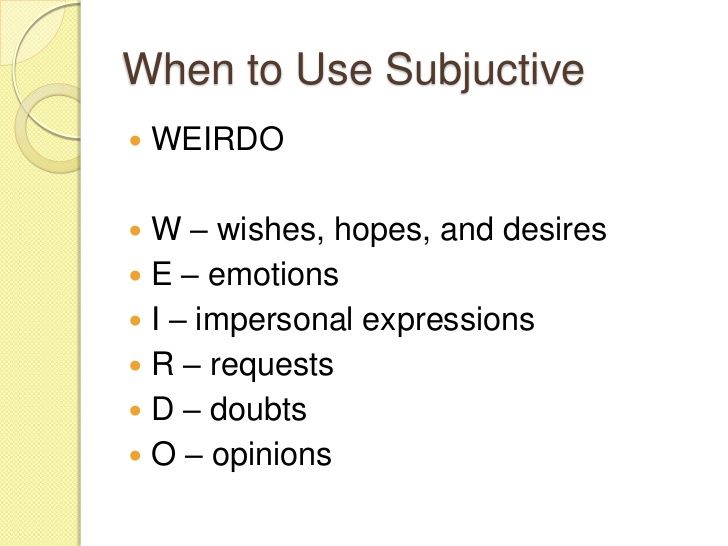
2.1 Remembering subjunctive triggers with WEIRDO
A helpful way to recognize when to use the subjunctive is by thinking of the acronym WEIRDO. Each letter stands for a type of trigger:
- W: Wishes or desires (e.g., vouloir que – to want that)
- E: Emotions (e.g., être content que – to be happy that)
- I: Impersonal expressions (e.g., il faut que – it is necessary that)
- R: Requests or recommendations (e.g., demander que – to ask that)
- D: Doubt or denial (e.g., douter que – to doubt that)
- O: Opinions or possibilities (e.g., il est possible que – it is possible that)
When you see these triggers in the main clause, the verb in the dependent clause normally uses the subjunctive.
2.2 Types of verbs and expressions that use the subjunctive
You can also think about subjunctive usage in three clear groups:
1. Verbs showing need, will, or advice: These include expressions like il faut que (it is necessary that), vouloir que (to want that), or suggérer que (to suggest that). For example, in il faut que tu fasses tes devoirs (it is necessary that you do your homework), fasses is subjunctive.
2. Verbs expressing emotions or feelings: Think of phrases like être content que (to be happy that), avoir peur que (to be afraid that), or être surpris que (to be surprised that). These all trigger the subjunctive because they show a personal reaction, not a fact.
3. Expressions showing doubt, possibility, or judgment: Phrases like il se peut que (it may be that), douter que (to doubt that), or c’est bizarre que (it’s strange that) call for the subjunctive because they signal uncertainty or judgment.
| Group | Example Phrase | Meaning |
|---|---|---|
| Desire/necessity | il faut que | it is necessary that |
| Emotion | être content que | to be happy that |
| Doubt/possibility | il se peut que | it may be that |
2.3 The subjunctive with conjunctions
The subjunctive also appears after some specific conjunctions that introduce dependent clauses. These conjunctions often show condition, purpose, or contrast. For example:
- à condition que (provided that)
- avant que (before)
- bien que (although)
- pour que (so that)
- sans que (without)
You must use the subjunctive after these words when the sentence shows uncertainty or intent.
One important exception is après que (after). Although it introduces a dependent clause, it is followed by the indicative, not the subjunctive, because it refers to a completed action.
Using the subjunctive properly will help you clearly express your feelings, doubts, or needs in French. For more examples of subjunctive usage, you can explore phrases like je doute que, il faut que, and être content que in your practice.
3. Indicative or subjunctive ?
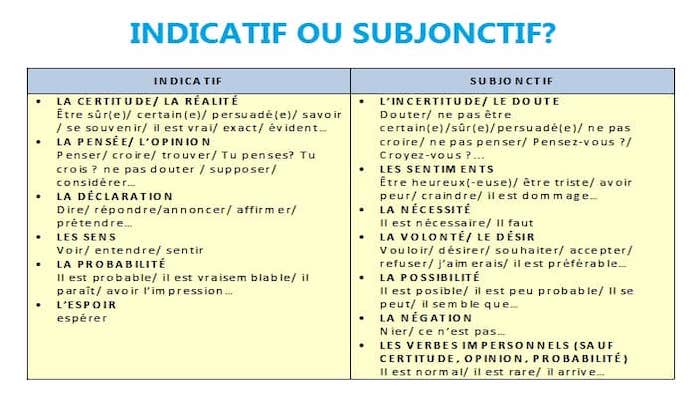
When you decide whether to use the indicative or the subjunctive in French, focus on the level of certainty or doubt in the sentence, especially in dependent or subordinate clauses.
3.1 The indicative mood
The indicative mood shows facts, truths, or things you are sure about. Use the indicative after expressions that state certainty, belief, or probability. For example:
| Expression in Affirmative | Meaning | Mood Used |
|---|---|---|
| Je pense que | I think that | Indicative |
| Je crois que | I believe that | Indicative |
| Il est certain que | It is certain that | Indicative |
| Il est probable que | It is likely that | Indicative |
These expressions show a belief or probability, even if not 100% sure, so the indicative fits best. You stick with the indicative because the action is considered real or very likely.
3.2 Using the negative
However, when these expressions are negated, your certainty weakens and you introduce doubt or emotion. In this case, you switch to the subjunctive mood. For example:
- Je ne crois pas que…
- Il n’est pas certain que…
- Je ne suis pas sûre que…
Here, your sentence shows uncertainty or disbelief. The subjunctive fits because it reflects feelings, doubts, or subjectivity in a dependent clause (a clause relying on the main clause).
If the person doing both actions is the same, or if you express a general rule, you can avoid the subjunctive entirely by using an infinitive instead. Compare:
- Il faut manger équilibré. (General statement — no subjunctive)
- Il faut que tu manges équilibré. (Specific advice — subjunctive)
3.3 The 'ne' expletif
The ne explétif is a special negative form sometimes seen with the subjunctive, but it does not change the negative meaning. It often appears in formal or literary styles after expressions of doubt or fear.
Remember, avoid the subjunctive if you are confident in the fact or action. Use it mainly when you express uncertainty, emotion, doubt, or need, especially within subordinate clauses. This choice shapes how your meaning comes across clearly and correctly in French.

4. The Past Subjunctive
4.1 How to form the past subjunctive
To create the past subjunctive, you combine the present subjunctive form of the auxiliary verbs être or avoir with the past participle of the main verb. This is similar to how the passé composé is formed, but you use the subjunctive mood for the auxiliaries instead of the indicative.
Use être as the auxiliary mainly with:
- Verbs of movement or staying still, including aller, venir, entrer, sortir, naître, mourir, monter, descendre, arriver, partir, rester, retourner, tomber
- Derived verbs like revenir, rentrer, remonter, redescendre, repartir
- Reflexive verbs, which always use être
For verbs using avoir, conjugate avoir in the present subjunctive and add the past participle. For example:
| Verb | Past Subjunctive (tu form) |
|---|---|
| voir | tu aies vu |
| partir | tu sois parti(e) |
| se lever | tu te sois levé(e) |
Make sure the past participle agrees in gender and number with the subject when the auxiliary is être or with reflexive verbs.
4.2 When to Use the Past Subjunctive
You use the past subjunctive when the action in the subordinate clause happens before the action in the main clause. This shows that the event is completed before the moment of speaking or before another past event. For example,
- Je suis contente que tu aies fini le travail : I am happy that you finished the work.
- Il est dommage qu’elle ne soit pas venue : It’s a shame she did not come.
The past subjunctive also expresses future actions you expect to finish by a certain time, since the subjunctive has no future tense.
- Il faudra que j’aie terminé avant midi : I’ll need to have finished before noon.
Finally, it expresses wishes about something already done or completed:
- Je voudrais qu’il soit déjà parti : I wish he had already left.
I hope you’ve found this article useful ! If you’d like to practice with grammar books, I highly recommend publications from CLE International. Their conjugation explanations are spot on and exercices well thought-out. Let me know what you think 🙂 I remain available for all your questions and for private tuition via my Contact page.
Comments are closed.