
Passé Composé Made Easy
The passé composé is one of the most important tenses you need to know in French.
For learners, it can feel confusing at first. But in this guide, we make the passé composé easy with clear explanations and real-life examples. It’s used to talk about completed actions and events in the past — things that happened and are now finished.
You’ll learn, with lots of practical phrases, what the passé composé is and how to form it.
Let’s dive in!

1. What is the Passé Composé?
The passé composé is one of the tenses colloquially used in French to talk about past event. It’s called in English the compound past or the present perfect. It refers to:
- something that happened once
- an event that happened at a specific time
- something that moved the story forward
Examples:
-
J’ai déjeuné à midi. (I had lunch at noon).
-
Nous avons travaillé hier. (We worked yesterday).
-
Ils sont allés à la plage la semaine dernière. (They went to the beach last week).
When you’re telling someone what happened yesterday or at a precise moment— you’re probably using passé composé.
If you’d like structured practice and feedback, my private online French classes are perfect for mastering tenses faster.
2. How to Form the Passé Composé
The passé composé is formed with:
Auxiliary verb (avoir or être) + past participle
2.1 The Passé Composé with Avoir
In French, the majority of verbs form the passé composé with the auxiliary avoir (to have). This includes regular verbs but also, unfortunately, many irregular verbs.
With a few exceptions (when the COD is placed before), the past participle does not agree in gender and number with the subject of the verb.
Both the verbs être and avoir form the passé composé with the auxiliary avoir:
-
être → j’ai été (I was)
-
avoir → j’ai eu (I had)”
2.1.1 Verbs of the 1st Group ending en -er
In French, the majority of verbs form the passé composé with the auxiliary avoir (to have). This includes regular verbs but also, unfortunately, many irregular verbs.
With a few exceptions (when the COD is placed before), the past participle does not agree in gender and number with the subject of the verb.
These regular verbs have a predictable pattern with a past participle always ending en -é :
| Verb | Past Participle | Example (French) | Example (English) |
|---|---|---|---|
| déjeuner | déjeuné | J’ai déjeuné à 13h | I had lunch at 1pm. |
| regarder | regardé | Elle a regardé Netflix. | She watched Netflix |
| travailler | travaillé | Nous avons travaillé dimanche. | We worked on Sunday. |
2.1.2 Some verbs of the 2nd and 3rd Group
However, many past participle are irregular. Here are a few as follows:
| Verb | Past Participle | Example (French) | Example (English) |
|---|---|---|---|
| dire | dit | Ils ont dit la vérité. | They told the truth. |
| écrire | écrit | J’ai écrit une lettre à ma sœur. | I wrote a letter to my sister. |
| faire | fait | Elle a fait ses devoirs hier. | She did her homework yesterday. |
| mettre | mis | Nous avons mis la table. | We set the table. |
| ouvrir | ouvert | Elle a ouvert la fenêtre. | She opened the window. |
| prendre | pris | J’ai pris le train ce matin. | I took the train this morning. |
2.1.3 Other verbs of the 3rd group
It helps to group verbs that have similar past participle endings. For instance, all of these verbs end in -u, which makes them easier to remember
| Verb | Past Participle | Example (French) | Example (English) |
|---|---|---|---|
| attendre | attendu | Vous avez attendu longtemps. | You waited a long time. |
| devoir | dû | Tu as dû partir tôt. | You had to leave early. |
| lire | lu | Nous avons lu ce livre. | We read this book. |
| perdre | perdu | Il a perdu ses clés. | He lost his keys. |
| recevoir | reçu | Elle a reçu une lettre. | She received a letter. |
| voir | vu | J’ai vu un film hier soir. | I saw a movie last night. |
If you’re unsure of the past participle or auxiliary, don’t forget to check the Bescherelle – French verb conjugation for reference.
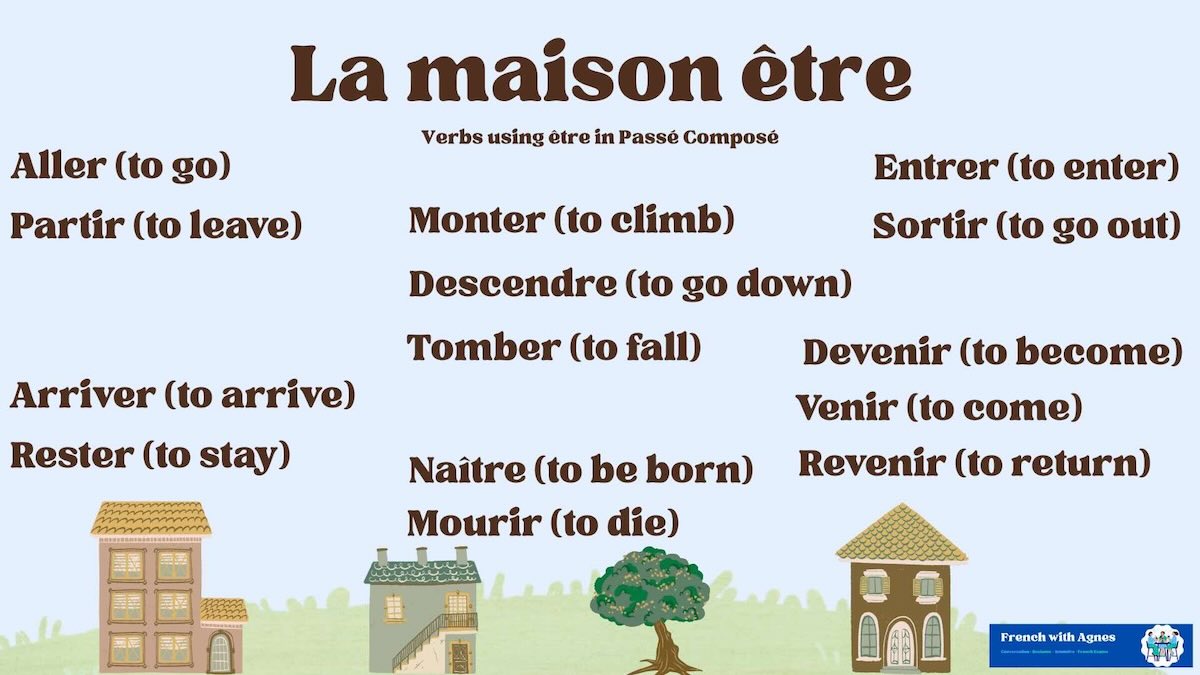
2.2 Verbs that use être (la maison être)
Some verbs don’t use avoir — they use être as the auxiliary.
You may know them as “la maison d’être” or maybe Mrs Vandertramp. They are : aller, venir, entrer, sortir, arriver, partir, monter, descendre, naître, mourir, rester, tomber, retourner, passer.
With être, the past participle changes based on gender and number:
- Add an -e for feminine.
- Elle est arrivée. (She arrived)
- Add an -s for plural
- Ils sont partis. (They left)
- Elles sont venues. (They came)
However, as always in French, we have a few exceptions.
Remember: The 6 verbs sortir, rentrer, monter, descendre, passer, retourner can use être or avoir when a direct object follows the verb, slightly changing the meaning.
Let see a few examples:
- Elle est montée dans son bureau. / Elle a monté son sac dans son bureau.
- She went upstairs to his office. / She took his bag up to his office.
- Elles sont passées à la boulangerie. / Elles ont passé une semaine chez moi.
- They went by the bakery. / They spent a week at my place.
2.3 Reflexive Verbs with être
All reflexive verbs (verbs with se at the infinitive) use être in the passé composé, no exceptions !
Structure: subject + reflexive pronoun + être + past participle
Examples:
-
Je me suis réveillé(e). (I woke up).
-
Tu t’es lavé(e). (You washed yourself).
-
Elle s’est préparée. (She got ready).
And just like other verbs with être, the past participle usually agrees with the subject:
-
Ils se sont levés.
-
Elles se sont couchées.
Learn everything you need about French past participle agreement in my dedicated article.
3. Practice Exercises: Passé Composé
Use the verbs from the table to complete the sentences in passé composé.
- Hier, j’________ (oublier) mon portefeuille.
-
Elle________ (faire) un gâteau au chocolat.
-
Nous ________ (aller) au bureau hier soir.
-
Elle ________ (offrir) un cadeau à sa mère
-
Nous ________ (mettre) les livres sur l’étagère.
-
Vous ________ (lire) ce livre la semaine dernière.
-
Ils ________ (partir) en vacances au Portugal.
-
Elle ________ (monter) au 2eme étage.
-
Tu________ (vouloir) apprendre le français.
-
Elles ________ (voir) Emily in Paris.
- Nous ________ (se réveiller) à 8 heures.
Conclusion
The passé composé is essential for talking about the past in French. By mastering avoir vs être, regular and irregular verbs, and reflexive verbs, you’ll be able to describe events, tell stories, and share experiences with confidence.
If you want personalized guidance, exercises, and feedback to master the passé composé and other French tenses, contact me for private lessons! I’ll help you learn faster and speak French more naturally.
(Answers: 1: j’ai oublié / 2: a fait / 3: sommes allé(e)s / 4: a offert / 5: avons mis / 6: avez lu / 7: sont partis / 8: est montée / 9: a voulu / 10: ont vu / 11. sommes réveillé(e)s)