
Qui vs Que in French: Relative Pronouns Explained
If you often hesitate between qui and que, you are not alone. This is a common question in my French lessons, but the distinction becomes much easier once you understand the role of each word. Mastering qui vs que in French, along with où and dont, will help you avoid repetition and build clearer, more natural sentences:
- Qui acts as the subject.
- Que is the direct object.
- Où refers to a place or time.
- Dont replaces phrases introduced by de or expresses possession.
This post will show how each pronoun works with short examples so you can spot and use them quickly in conversation and writing. Expect clear rules for “qui” and “que”, easy tips for quand to use “où”, and a quick trick to remember when to use “dont” instead of repeating de. Once you feel comfortable using these relative pronouns, connecting your ideas and speaking naturally will become much easier. If you would like to practise them in real conversations and receive personalised feedback, discover my French conversation lessons.
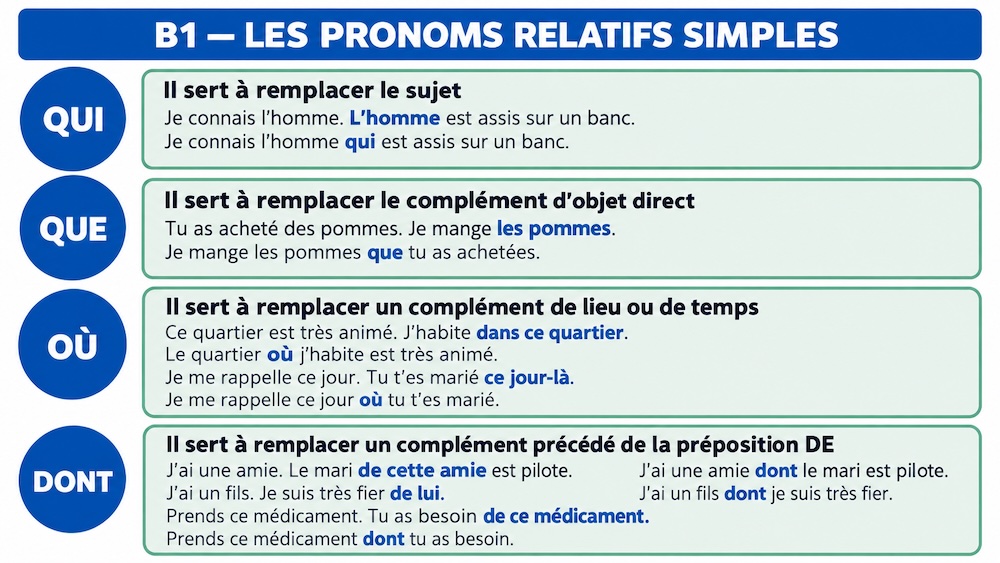
1. Qui as a subject pronoun
French relative pronouns link a main clause to a dependent clause and replace a noun to avoid repetition. The pronoun “qui” can substitute for a person or an object, and it differs from the interrogative pronoun “qui'” which is exclusively used for individuals. It links the clause to a main noun without repeating that noun.
1.1 Role and Structure
When you use “qui”, it stands for the subject of the relative clause. Place “qui” directly before the verb of the relative clause: for example, “la femme qui parle” where qui = “who” and “parle” is the verb. ‘Qui’ never changes form for gender or number. The main clause supplies the noun that qui refers to, so you do not add another subject inside the relative clause.
Use “qui” for people and things when they perform the action in the relative clause. Remember that “qui'”corresponds to English “who,” “that,” or “which” when it functions as subject.
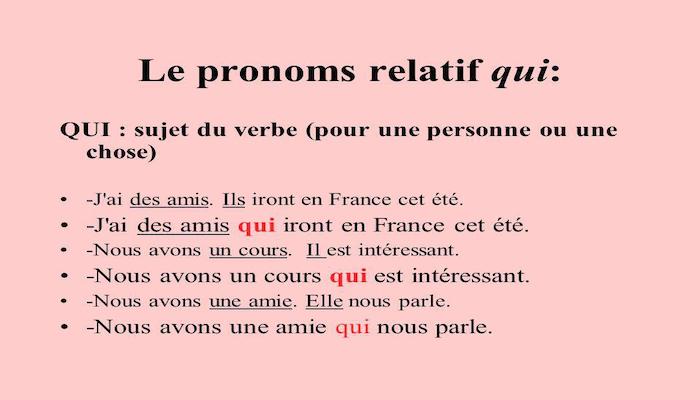
1.2 Typical Examples and Translations of Qui
- “L’enfant qui joue est fatigué.”
You read this as “The child who is playing is tired.” Qui stands for the child and comes before “joue.” - “Le livre qui m’intéresse est rare.”
Translate as “The book that interests me is rare.” Qui is subject of “intéresse.” - “Les amis qui viennent sont sympas.”
Means “The friends who are coming are nice.” Qui matches plural verb “viennent.”
In each case, identify the main noun first, then replace its repeated role in the subordinate clause with “qui”. For translation, choose “who” for people and “that/which” for things depending on style.
2. Que and Qu’ as Object Pronouns
“Que” functions as the relative pronoun that replaces a direct object in a relative clause. It becomes qu’ before a vowel or mute h to keep speech smooth. You will see “que” translate as “that,” “which,” or sometimes “whom” in English, depending on context.
2.1 Direct Object Usage
Use “que” when the noun in the main clause is the direct object of the verb in the relative clause.
Example pattern: [main noun] + que + [subject] + [verb]. For instance: Le livre que tu lis — “the book that you are reading.” Here le livre is the object of lis.
“Que” can refer to people or things. When it refers to a person, English may read it as “whom,” though French still uses que. You must not change “que” form for gender or number; it stays invariable.
2.2 Rules for Elision (Qu’)
Elide “que” to qu’ before a word that starts with a vowel sound or a mute h.
For example: L’homme qu’on connaît instead of que on connaît. This avoids the awkward vowel collision in speech.
Elision is mandatory in writing and speech whenever the following word begins with a vowel or mute h. Do not elide before a consonant or aspirated h. Spelling stays normal elsewhere: la chose que j’ai vue vs la chose qu’il fait.
Remember that elision does not change function: qu’ still marks the direct object. Pronunciation links the words smoothly; writing uses an apostrophe to show the contraction.
2.3 Agreement in Past Participle
Watch for agreement in past participles in Passé Composé, with “que” when the auxiliary is avoir: the past participle agrees with the direct object preceding it.
Example: Ce sont les lettres que j’ai lues — lues agrees with les lettres.
But we would have : J’ai lu ces lettres.
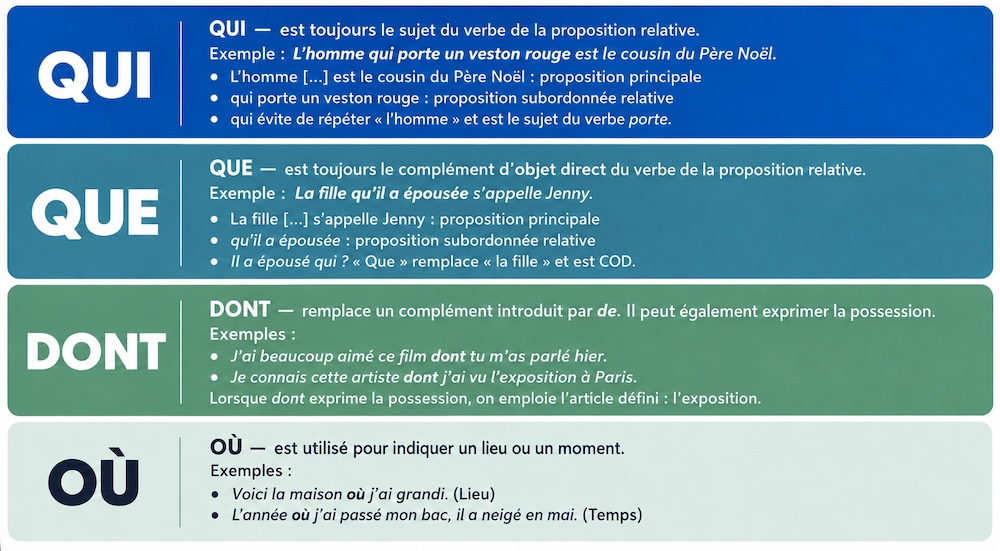
3. Où and Dont: Expressing Place, Time, and Relationships
“Où” points to a place or time and replaces phrases like “in which” or “when.”
“Dont” connects to a verb or noun that uses de and can mean “of which,” “whose,” or “about which.”
3.1 Où: Place and Time References
Use “où” when the clause refers to a place or a time.
1. For place: replace a location phrase such as “à Paris” or “dans la maison.” Example pattern: “La ville où j’habite” = “The city where I live.”
2. For time: use “où” to mean “when” or “in which.”
Example: “Le jour où tu es né” = “The day when you were born.”
3.2 Dont: Links with 'De' and Possession
Use “dont” when the relative clause needs the preposition de.
1. “Dont” works as the indirect object for verbs that take de (parler de, avoir besoin de, se souvenir de, avoir peur de,…). For example,
- Le livre dont tu parles est vieux (parler de quelque chose)
- La méthode dont ils se servent marche bien (se servir de)
2. “Dont” also replaces “de + noun” and often shows possession or relationship. For possessive ideas you can often translate “dont” as “whose.” For instance,
- Je te présente Marie, dont nous avons rencontré le frère hier (le frère de Marie)
- Le sac, dont la fermeture est cassé, est à ma mère (la fermeture du sac)
Ready to Make Further Progress in French?
I’d love to help you build your confidence and make further progress with personalized French lessons.
Comments are closed.