
Imparfait or Passé Composé: A Complete Guide for Learners
Last updated date : 1st January 2026
Learning how to talk about the past in French can be tricky. Unlike English, which often uses a single past tense, French has two main past tenses. Choosing between imparfait and passé composé can completely change the meaning of your sentence.
This guide will help you:
- understand the key differences
- explain when to use each tense
- provide plenty of examples and exercises.
So you will feel confident telling stories in the past in French.
1. Quick Comparison: Imparfait vs Passé Composé
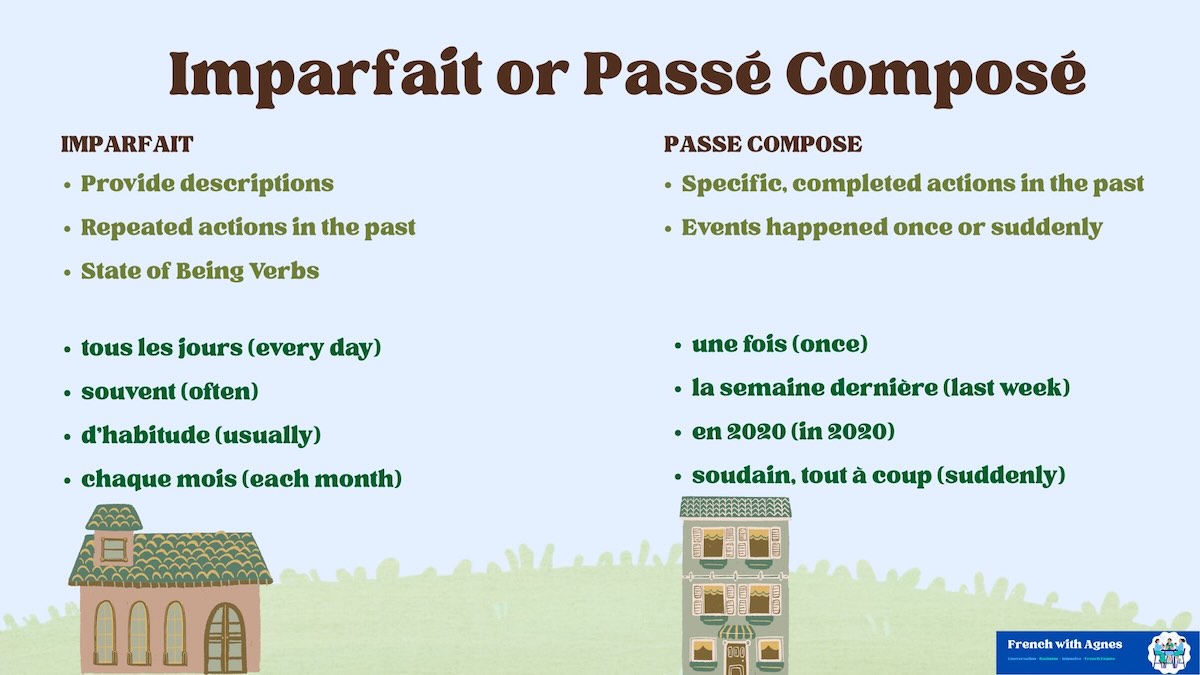
Before learning the rules in detail, it’s helpful to see a quick comparison of Imparfait vs Passé Composé. This table highlights the key differences between these French past tenses, shows when to use each one, and provides example sentences.
Use it as a quick reference to understand how to tell stories, describe past events, and set the scene in French.
| Feature | Imparfait | Passé Composé | Example |
|---|---|---|---|
| Type of action | Ongoing, habitual, background | Completed, specific events |
|
| Time reference | General or unspecified | Specific moment or duration |
|
| Storytelling role | Scene-setting, description | Action/plot |
|
| Common keywords | toujours, souvent, tous les jours, pendant que,.. | hier, soudain, tout à coup, une fois,.. |
|
Looking for more practice and genuine conversation? Consider taking online French lessons where you can focus on imparfait versus passé composé with organized support.
2. How to decide to use Imparfait or Passé Composé
To choose the right tense, ask yourself:
1. Am I describing how things were or what happened?
-
-
How things were → imparfait
-
What happened → passé composé
-
2. Am I setting the scene or narrating events?
-
-
Scene/background → imparfait
-
Actions that move the story → passé composé
-
3. Are there time markers?
-
-
Imparfait: souvent, d’habitude, tous les jours
-
Passé composé: hier, soudain, une fois
-
4. How to translate in English ?
-
- Imparfait often becomes English “was/were + -ing” or “used to”
- Passé composé usually becomes simple past or present perfect in English.
3. Understanding l'Imparfait
The imparfait is used for ongoing, habitual, or repeated actions in the past. It also describes people, places, situations, and emotions, setting the scene—like painting the background in a story.
Key Uses of Imparfait:
-
Habitual actions:
Quand j’étais enfant, je jouais au parc tous les jours.
(When I was a child, I used to play in the park every day.) -
Ongoing actions:
Je lisais un livre quand il a commencé à pleuvoir.
(I was reading a book when it started to rain.) -
Descriptions:
Il faisait froid et le vent soufflait fort.
(It was cold and the wind was blowing strongly.) -
Emotions or mental states:
J’étais triste ce jour-là.
(I was sad that day.)
Tips:
-
Think of imparfait as painting the scene.
-
Often used with while/when: pendant que, lorsque.
4. Grasping the Passé Composé
The passé composé is used for specific, completed actions in the past. It moves the story forward, describing events that happened once or were fully completed.
Key Uses of Passé Composé:
- Actions that happen a specific number of times or are clearly completed: J’ai déjà vu ce film deux fois.
(I’ve already seen this movie twice.) -
Actions with a clear beginning and end: Il a commencé son travail à 9h.
(He started work at 9 a.m.) -
Interrupting actions: Je lisais un livre quand mon ami est arrivé.
(I was reading a book when my friend arrived.)
Remember:
-
Think of passé composé as moving the story forward.
-
Usually paired with specific time markers.
5. Time Expressions to Identify Each Tense
Certain time connectors can also indicate whether to use imparfait or passé composé. Look for the following time indicators:
| Tense | French Phrase | English Translation |
|---|---|---|
| Imparfait | tous les jours | every day |
| souvent | often | |
| d’habitude | usually | |
| chaque mois / chaque année | each month / each year | |
| habituellement | in general | |
| Passé composé | une fois | once |
| la semaine dernière | last week | |
| en 2000 | in 2000 | |
| un jour | one day | |
| soudain / tout à coup | suddenly | |
| hier | yesterday |
For example:
-
Chaque année, je voyage en Floride → habitually (imparfait)
-
En 2018, je suis allée en Floride → completed event (passé composé)
For home study, I recommend using a conjugation app such as Le Bescherelle or Le Conjugueur. They offer numerous practical exercises that are crucial for mastering French grammar.
6. Using Imparfait and Passé Composé Together
It’s common to use both tenses in a single sentence to describe the past:
Pattern: Background / Ongoing Action (Imparfait) + Interrupting Event (Passé Composé)
Examples:
-
Je marchais dans le parc quand il a commencé à pleuvoir.
(I was walking in the park when it started to rain.)
-
Nous regardions un film quand le téléphone a sonné.
(We were watching a movie when the phone rang.)
This combination is extremely common in storytelling and makes your French sound natural.
7. Practice Examples / Exercises
Fill in the blanks with imparfait or passé composé:
(Answers below)
1. Je (aller) chez le coiffeur la semaine dernière.
2. Quand il (être) adolescent, il (jouer) au basketball.
3. À cette époque-là, ils (tenir) une boulangerie à Nice.
4. Elles (randonner) dans les Pyrénées cet été
5. Nous (dîner) dans cette brasserie tous les mercredi.
6. Je (faire) mes courses quand je (rencontrer) Marie.
7. Il (rougir) en la voyant.
8. Chaque semaine, il (s’entrainer) dans un club de tennis
9. Je (regarder) Netflix quand elle (arriver) .
10. La plage (être) si belle.
Your Next Steps in Learning French
Mastering imparfait and passé composé is essential for fluent French. Focus on:
-
Understanding the difference between background and action
-
Using time expressions to guide your tense choice
-
Practicing regularly with stories, reading, and exercises
With consistent practice, you’ll soon be telling past stories in French naturally and confidently.
If you ever feel stuck or just want some extra tips with personalized guidance, don’t hesitate to contact me — I’d love to help you on your French-learning journey!
(Answers: 1. suis allé(e) / 2. était – jouait / 3. tenaient / 4. ont randonné / 5. dinions / 6. faisais – j’ai rencontré / 7. a rougi / 8. s’entrainait / 9. regardais – est arrivée / 10. était)
Comments are closed.