Top 100 Beginner French Phrases for Daily Conversation
These 100 beginner French phrases will help you handle everyday conversations in France, from greeting someone and asking for help to shopping, dining out and dealing with an emergency.
The expressions are grouped by situation and accompanied by English translations and practical usage notes, so you can understand when and how to use them.
If you would like to practise these phrases in real conversations and receive personalised feedback, discover my online French Conversation Lessons.

1. Fundamental French Greetings and Courtesies
Polite greetings and courtesies help start conversations on the right note. Use the correct phrase for the time of day, add politeness words, and introduce yourself clearly.
1.1 Key Greetings and Goodbyes
Use bonjour during the day and bonsoir in the evening. Salut is more casual and is generally used with friends and people you know. Remember that bonne nuit is normally said when someone is going to bed, rather than as a general evening goodbye. You can also discover different ways to say thank you in French, from merci to more formal expressions
- 1. Bonjour, bonsoir — Hello or good morning / good evening
-
2. Salut — Hi (casual)
-
3. Bonne journée, bon(ne) après-midi— Have a good day, a good afternoon (feminine or masculine)
-
4. Bonne soirée, bonne nuit — Have a good evening, a good night
-
5. Comment ça va ? — How’s it going?
-
6. Ça va. — I’m fine.
-
7. Ça ne va pas. — Not great.
-
8. Enchanté(e) / Ravi(e) de te/vous rencontrer. — Nice/pleased to meet you.
-
9. Merci / Je vous remercie (more formal) — Thank you / I thank you
-
10. C’est gentil — That’s kind
Use tu with friends, relatives, children and people you know well. Use vous when addressing someone you do not know, in a formal situation or when speaking to more than one person. In some modern workplaces, colleagues may agree to use tu.
1.2 Polite Expressions for Everyday Situations
Politeness keeps conversations smooth. Say “s’il vous plaît” when asking for something formally and “s’il te plaît” with friends. Common quick lines:
-
11. S’il vous plaît. — Please (formal)
-
12. S’il te plaît. — Please (informal)
-
13. Excusez-moi. — Excuse me.
-
14. Pardon. — Sorry / passing by
-
15. Je suis (vraiment) désolé(e). — I’m (truly) sorry.
-
16. Pas de problème / Aucun problème / Pas de souci. — No problem / no worries.
-
17. Bien sûr, d’accord. — Of course, agreed / Ok
-
18. Je comprends / Je ne comprends pas — I understand / I don’t understand
- 19. De rien. — You’re welcome.
-
20. Je t’en prie / Je vous en prie — You’re welcome (informal / formal)
This final expression is, in fact, the older French term for “I beg you,” which gradually evolved into “you’re welcome / please / go ahead.” as shown:
-
je = I
-
te / vous = you
-
en = “of it / about that” (referring to what was just said or asked)
-
prie = from prier → “to beg, to request, to implore” (same root as prayer, from Latin precari)
1.3 Asking for Help
Knowing how to ask for help is essential in everyday conversations. These simple questions can help when you do not understand something or need practical assistance. You can also review the different ways of asking questions in French.
-
21. Pouvez-vous m’aider ? — Can you help me?
-
22. Comment on dit… en français ? — How do you say… in French?
-
23. Qu’est-ce que ça veut dire ? — What does that mean?
-
24. Pouvez-vous répéter ? — Can you repeat?
-
25. Plus lentement, s’il vous plaît. — Slower, please.
-
26. Pouvez-vous me montrer…, s’il vous plaît. — Can you show me, please.
-
27. Où puis-je trouver… ? — Where can I find…?
-
28. C’est possible ? — Is it possible?
-
29. Ça marche / Ça roule — It workds
-
30. Merci pour ton / votre aide. — Thanks for your help.
To show even greater politeness, we often employ the conditional tense at a more sophisticated level.
You might already be familiar with some expressions such as “je voudrais” (I would like) or “est-ce que je pourrais avoir..?” (Could I have..?).
1.4 Daily Small Talk
A bit of casual conversation can make a big difference in French. Here are some of the most frequently used everyday phrases, along with examples and brief notes to help you sound more natural :
- 31. Qu’est-ce que tu fais aujourd’hui ? — What are you up to today? (casual)
- 32. Il fait beau / chaud / froid — It’s nice/hot/cold
- 33. Tu travailles / bosses dans quoi ? — What do you do for work? (“bosser” is familiar language)
- 34. Tu viens souvent ici ? — Do you come here often?
- 35. C’est intéressant / ennuyeux — That’s interesting / boring
- 36. Vraiment ? / C’est vrai ? — Really ? / Is it true ?
- 37. Tu en penses quoi ? — What do you think about it ?
- 38. C’est pas mal. — It’s not bad (We tend to drop the “ne” in conversation)
- 39. Je suis fatigué(e). — I’m tired.
- 40. Je ne suis pas libre demain, je suis occupé(e). — I’m not free tomorrow, I’m busy.
“C’est pas mal” means it’s not bad but can mean “It’s pretty good!” or “Not bad at all.” So it’s mildly positive, not neutral. French speakers often use it when they like something, just not over-the-moon about it.
2. Beginner French Phrases for Real-Life Situations
These beginner French phrases are useful when travelling, shopping or eating out in France. Learning a few complete expressions will help you communicate more confidently in common real-life situations
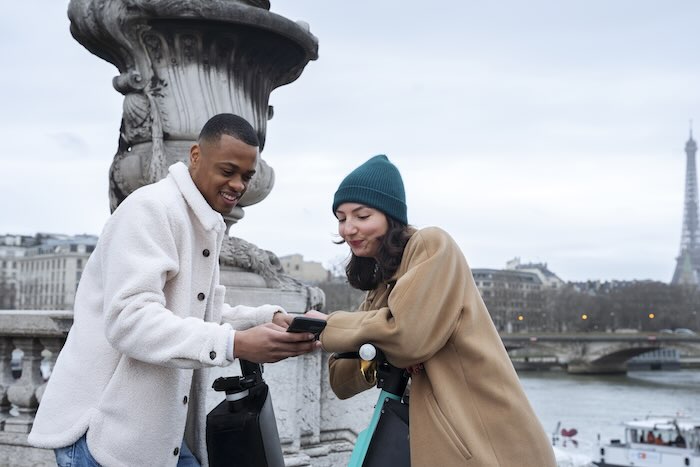
2.1 Asking for Directions and Travelling in France
When you travel to France, you may need help with directions. Getting around in France is much easier if you know some directions and navigation phrases. Here’s a practical guide.
-
41. Où est / Où sont… ? or Où se trouve(nt)…? — Where is…./ Where are ?
-
42. À droite / À gauche — To the right / to the left
-
43. Au bout de la rue / du couloir —At the end of the street / hallway
-
44. Tout droit — Straight ahead (be careful as the pronunciation is different than “à droite”)
-
45. Près / loin d’ici ? — Near / far from here?
-
46. Je cherche… — I’m looking for…
-
47. En voiture vs à pied — By car or by foot (“en” when you are in the transportation)
-
48. Combien de temps dure le trajet ? — How long does the journey take?
-
49. À quelle heure passe le bus ? — At what time does the bus arrive?
-
50. Je suis (un peu) perdu(e). — I’m (a little bit) lost.
2.2 Going Shopping
Shopping in France becomes much easier when you know a few useful expressions. Remember that une taille refers to clothing size, while une pointure is used for shoe size.
-
51. Combien ça coûte ? — How much does it cost ?
-
52. Désolé(e), c’est trop cher / C’est bon marché — Sorry, it’s too expensive / It’s affordable
-
53. Je regarde / Je jette un coup d’oeil — I’m just looking.
-
54. Avez-vous une autre taille / une autre couleur ? — Do you have another size / another color?
-
55. Où sont les cabines d’essayage ? — Where are the fitting rooms?
-
56. Est-ce que je peux essayer ? — Can I try ?
-
57. Je le / la / les prends. — I’ll take it / them
-
58. Je peux payer par carte / en espèces ? — Can I pay by card / in cash ?
-
59. Je peux avoir le ticket de caisse, s’il vous plaît ? — Can I have the receipt, please ?
-
60. Est-ce qu’il y a une garantie ? — Is there a warranty?
2.3 Dining Out in France
Here’s a handy dining-out phrase kit for French restaurants, cafés, and bakeries.
These are exactly what you’ll hear and what locals actually say :
-
61. Une table pour deux / Deux couverts, s’il vous plaît. — A table for two, please.
-
62. Est-ce qu’on peut s’asseoir en terrasse ? – Can we sit outside?
-
63. Je pourrais avoir la carte, s’il vous plaît ? — Could I have the menu, please ?
-
64. Qu’est-ce que vous me / nous recommandez ? — What do you recommend ?
-
65. Quel est le plat du jour ? — What’s today’s special?
-
66. Et avec ceci ? / C’est tout or ce sera tout — Anything else ? / That’s all or That will be all
-
67. Une carafe d’eau, s’il vous plaît — A jug of tap water, please. (totally normal to ask!)
-
68. L’addition, s’il vous plaît. — The bill, please.
-
69. Est-ce que c’est inclus / compris ? — Is it included?
-
70. Sur place ou à emporter — Eat in or to takeaway?
In France, tipping is way simpler than in the U.S. Tip is already included in restaurant prices (“service compris”). So you don’t have to tip. However most locals still leave a little something when service is nice. For restaurants, we generally leave 5–10% or more for exceptional service.
3. Social Expressions for Everyday Conversations
These phrases help you start polite conversations, show respect, and leave a positive impression. Use the right greeting for the time of day, add simple politeness words, and state your name or role clearly.
3.1 Staying in Touch
Here are natural French phrases for staying in touch, whether you’re saying goodbye, texting later, or reconnecting :
-
71. On se voit bientôt ? — Shall we see each other soon?
-
72. À tout’ / à tout de suite. — See you shortly (in a few minutes or hours)
-
73. À tout à l’heure —See you later (generally the same day)
-
74. À (très) bientôt. — See you (very) soon
-
75. Tiens-moi au courant — Keep me updated
-
76. Bon week-end ! / Bonnes vacances — Have a good weekend! / good vacation
-
77. On s’écrit ? / On s’appelle ? —Shall we text each other? / Shall we call each other?
-
78. Tu peux me donner ton numéro ? — Can you give me your number ?
-
79. On reste en contact. — Let’s keep in touch.
-
80. Tu es dispo quand ? — When are you free? (“dispo” for “disponible”)
In a professional environment, we say “je reviens vers vous,” which translates to “I’m getting back to you.”
3.2 At Home and in Daily Life
Now, let’s explore some useful French phrases for home and daily life. These are the types of expressions that people commonly use at home :
-
81. J’ai faim / soif. — I’m hungry / thirsty
-
82. J’ai chaud / froid — I’m hot / cold
-
83. On y va — Let’s go
-
84. Fais comme chez toi / faites comme chez vous — Make yourself at home.
-
85. J’ai besoin de /envie de… — I need / I feel like..
-
86. Ça me plaît / ça ne me plaît pas — I like it / I don’t like it
-
87. Il faut faire la lessive / la vaisselle — We have to do the laundry / the dishes
-
88. Ça suffit ! / J’en ai marre ! — That’s enough! / I’m fed up !
-
89. Attends-moi ! — Wait for me !
-
90. C’est prêt. — It’s ready.
3.3 Health and Emergencies
Here’s a useful collection of French phrases for health concerns and emergencies. These are the phrases you’ll truly need if something goes awry. Keep them close at hand :
-
91. J’ai besoin d’un médecin — I need a doctor
-
92. J’ai mal au ventre / à la tête / aux pieds — I have a stomach ache / a headache / sore feet
-
93. J’ai du mal à respirer — I have difficulty breathing
-
94. Je ne me sens pas bien — I don’t feel well
-
95. C’est une urgence — It’s an emergency
-
96. Est-ce qu’il faut une ordonnance ? — Do I need a prescription ?
-
97. Où est l’hôpital le plus proche ? — Where is the nearest hospital?
-
98. Je tousse beaucoup — I’m coughing a lot.
-
99. Je me suis coupé(e) / brûlé(e) — I’ve cut myself/ burnt myself.
-
100. Ça va aller. — It’s going to be okay.
Tip :
- we use “avoir mal au / à la / aux” along with a body part masc. or fem.) to indicate pain.
- However, we say “avoir du mal à” when referring to difficulties in doing something.
How to Practise These Beginner French Phrases
These 100 beginner French phrases provide a practical foundation for everyday conversations. Review them regularly and try to associate each expression with a specific situation rather than memorising the entire list at once.
You can practise by creating short dialogues, recording your voice or reviewing ten phrases each day. The more often you use them in context, the more naturally they will come to mind.
If you would like personalised support with your pronunciation and spoken French, contact me to discuss your goals.