
How to Ask Questions in French: 3 Essential Structures
Knowing how to ask questions in French is essential if you want to have real conversations, whether you are meeting someone, travelling, ordering in a restaurant or asking for help. The good news is that French questions follow a few clear patterns. Once you understand them, you can choose a structure that suits both the situation and the level of formality.
In this guide, you will discover how to form French questions using intonation, est-ce que and inversion. You will also find useful question words, formal and informal structures, and common mistakes to avoid. If you would like to practise asking questions in real conversations and receive personalised feedback, my French Conversation Lessons can help you speak with greater confidence.

1. The Three Ways to Ask Questions in French
There are three main ways to ask questions in French: raising your intonation, using est-ce que, or inverting the subject and the verb. The meaning can remain the same, but the structure and register change.
Questions with Intonation
The simplest way to form a French question is to keep normal sentence order and raise your voice at the end. This structure is very common in everyday spoken French.
- Tu viens ce soir ? (Are you coming tonight?)
- Vous habitez ici depuis longtemps ? (Have you lived here for a long time?)
You can also use a question word while keeping standard word order:
- Tu vas où ? (Where are you going?)
- Vous en pensez quoi ? (What do you think about it?)
These structures are frequent in spoken French, but some of them may sound too informal in formal writing or professional situations.
Using Est-ce que to Ask a Question
Est-ce que is an easy and reliable way to ask questions in French. Simply place it before a statement without changing the usual subject-verb order.
- Est-ce qu’elle va bien ? (Is she well?)
- Est-ce que vous avez des croissants ? (Do you have any croissants?)
Before a vowel or silent h, que becomes qu’. This neutral structure is suitable for most everyday situations.
Est-ce que is neutral and works well in most everyday situations. It is especially useful for learners because you do not need to change the order of the subject and verb.
Questions with Inversion
Inversion places the conjugated verb before the subject pronoun, with a hyphen between them. This structure is mainly used in formal French and writing.
- Viens-tu ce soir ? (Are you coming tonight?)
- Où allez-vous ? (Where are you going?)
With a noun subject, repeat the subject using the corresponding pronoun:
- Marie vient-elle ce soir ? (Is Marie coming tonight?)
Before il, elle or on, add -t- when the verb ends in a vowel:
- Parle-t-il français ? (Does he speak French?)
The t is added only to make the question easier to pronounce.

2. French Question Words and How to Use Them
French question words help you ask for specific information rather than a simple yes or no. They can be used with intonation, est-ce que or inversion, depending on the register you need.
| Interrogative word | Translation | Examples |
| Combien ? | How many ? How much ? |
Combien ça coûte ? |
| Comment ? | How ? What ? | Comment ça va ? |
| Quand ? | When ? | Quand viens-tu me voir ? |
| Où ?
Preposition + où ? |
Where ? | Où vas-tu ?
D’où venez-vous? |
| Pourquoi ? | Why ? | Pourquoi tu es en retard ? |
| Que / Qu’/ Quoi ?
Preposition + quoi ? |
What ? | Que se passe-t-il?
A quoi tu tu penses ? |
| Quel /Quelle/Quels/Quelles ? | Which ? | Quelle est ta couleur préférée? |
| Lequel/Laquelle/Lesquels/Lesquelles ? | Which ones ? | Lequel tu veux ? |
| Qui ?
preposition + qui ? |
Who ?
to/with/for whom? |
Qui est là ?
Avec qui tu parles ? |
Asking Questions with Qui
Use qui to ask about a person. When qui is the subject of the verb, it can be followed directly by the verb:
- Qui vient ce soir ? (Who is coming tonight?)
When asking about the person receiving the action, you can use qui est-ce que or inversion:
- Qui est-ce que tu invites ? (Who are you inviting?)
- Qui invites-tu ? (Who are you inviting?)
After a preposition, use qui:
- Avec qui tu parles ? (Who are you talking to?)
- Pour qui est ce cadeau ? (Who is this present for?)
Do not confuse interrogative qui and que with relative pronouns. If you would like to review that separate grammar point, read this guide to the French pronouns qui and que.
Asking Questions with Que, Qu’est-ce que and Quoi
French has several ways to ask “what”. Your choice depends on the structure and register of the question.
Use qu’est-ce que before a subject and verb in a neutral question:
- Qu’est-ce qu’ils font ? (What are they doing?)
- Qu’est-ce que tu voudrais comme dessert ? (What would you like for dessert?)
Use que before inversion in a more formal question:
- Que voulez-vous ? (What do you want?)
- Use quoi at the end of an informal question or after a preposition:
- Tu fais quoi ? (What are you doing?)
- À quoi tu penses ? (What are you thinking about?)
- De quoi avez-vous besoin ? (What do you need?)
When “what” is the subject of the verb, use qu’est-ce qui:
- Qu’est-ce qui se passe ? (What is happening?)
Choosing the Correct Form of Quel
The French question word quel agrees in gender and number with the noun it describes. Use quel with a masculine singular noun, quelle with a feminine singular noun, quels with a masculine plural noun and quelles with a feminine plural noun.
- Quel film veux-tu voir ? (Which film do you want to see?)
- Quelle est ta couleur préférée ? (What is your favourite colour?)
- Quels livres est-ce que vous recommandez ? (Which books do you recommend?)
- Quelles langues parlez-vous ? (Which languages do you speak?)

Want to Ask Questions More Naturally in French?
Knowing the grammar is an excellent start, but forming questions spontaneously requires practice. In my French Conversation Lessons, you can practise choosing the right structure, improve your pronunciation and receive personalised feedback in realistic conversations.
3. Formal and Informal Questions in French
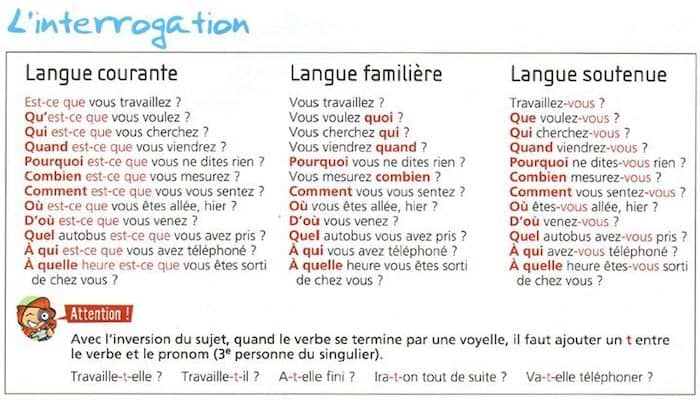
French questions change according to the situation and the person you are speaking to. Intonation is common in relaxed conversation, est-ce que is generally neutral, and inversion is more formal.
| Informal spoken French | Neutral French | More formal French |
|---|---|---|
| Tu vas où ? (Where are you going?) | Où est-ce que tu vas ? (Where are you going?) | Où vas-tu ? (Where are you going?) |
| Tu fais quoi ? (What are you doing?) | Qu’est-ce que tu fais ? (What are you doing?) | Que fais-tu ? (What are you doing?) |
| Il arrive quand ? (When is he arriving?) | Quand est-ce qu’il arrive ? (When is he arriving?) | Quand arrive-t-il ? (When is he arriving?) |
In everyday speech, native speakers frequently use intonation and place the question word at the end. This is natural, but it is still important to recognise est-ce que and inversion because you will hear and read all three forms.
Choose vous when speaking to someone you do not know, an older person, a client or a group. Use tu with friends, relatives, children and people who have invited you to address them informally. The choice between tu and vous also affects how polite a question sounds.
To make your conversations flow more naturally, combine good question structures with these French phrases that help you sound more natural.
4. How to Ask Negative Questions in French
French questions change according to the situation and the person you are speaking to. Intonation is common in relaxed conversation, est-ce que is generally neutral, and inversion is more formal.
Negative questions in French follow the same three structures, but the negative words surround the conjugated verb. Ne comes before the verb, while pas normally follows it.
- Vous n’avez pas soif ? (Aren’t you thirsty?)
- Est-ce que vous n’avez pas soif ? (Aren’t you thirsty?)
- Ne voulez-vous pas entrer ? (Don’t you want to come in?)
When answering a negative question, use si to contradict the negative idea:
- Vous ne venez pas ? Si, je viens. (Aren’t you coming? Yes, I am.)
- Non, je ne viens pas. (No, I’m not.)
For a complete explanation of word order with ne… pas, pronouns and compound tenses, see how to make negative sentences in French.
5. How to Make French Questions More Polite
French questions change according to the situation and the person you are speaking to. Intonation is common in relaxed conversation, est-ce que is generally neutral, and inversion is more formal.
Polite French questions depend on your choice of pronoun, structure and wording. Using vous and est-ce que is often sufficient, while the conditional can make a request softer and more courteous.
- Est-ce que vous avez des croissants ? (Do you have any croissants?)
- Pourriez-vous m’aider ? (Could you help me?)
- Est-ce que je pourrais réserver une table ? (Could I reserve a table?)
- Qu’est-ce que vous me conseillez ? (What do you recommend?)
The conditional is not required for every polite question, but it is particularly useful for requests. You can review its formation and uses in this lesson on the French present conditional.
Practise Asking Questions in Real French Conversations
As you gain confidence, focus less on translating from English and more on selecting a complete French question pattern. Regular speaking practice will help these structures become automatic.
If you would like personalised support, contact me to discuss your goals and find the most suitable way to improve your spoken French.
Comments are closed.