
Master the French Pronouns 'En' and 'Y'
Would you like to master the French pronouns en and y and use them more naturally in conversation? These small words help you avoid repetition, but choosing the right one and placing it correctly can be difficult for French learners.
The difficulty is knowing which one to choose. “When should I use ‘en’ or ‘y’?”
In this guide, you will learn when to use en and y, where to place them and which common mistakes to avoid. You will also find clear examples and a short exercise to help you practise. If you would like to apply these rules in conversation, my online French lessons can be adapted to your level and learning goals.

1. When do we use the French pronoun en ?
Like other French pronouns, en replaces information that has already been mentioned and helps avoid repetition. As explained in my simple guide to French pronouns, its form does not change according to the gender or number of the noun it replaces. Let’s look at its main uses.
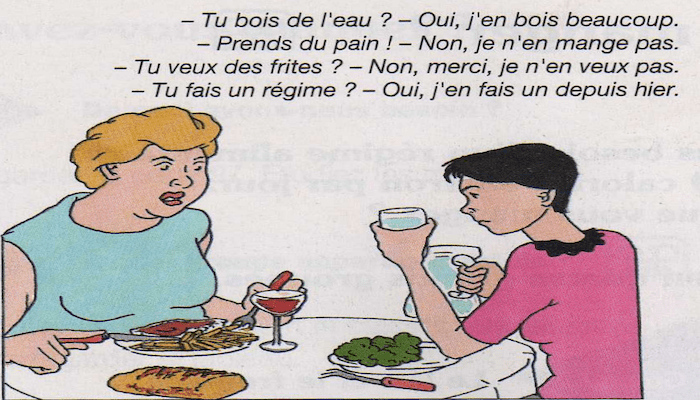
To replace an indefinite or partitive article
Use en to replace a noun introduced by un, une, du, de la, de l’ or des. We can also specify the quantity.
ex : Est-ce que vous avez du beurre salé ?
Oui, nous en avons au fond du magasin (unspecified quantity)
Oui, nous en avons 3 cartons (specified quantity)
Non, malheureusement, nous n’en avons plus (négative)
= Do you have salted butter ?
Yes, we have some at the back of the store
Yes, we have 3 boxes (of it)
No, unfortunately we don’t have any more
The noun beurre salé disappears because en replaces it.
Note: The answer may sound incomplete if you do not specify the quantity. Here, Oui, j’en ai simply means “Yes, I have some”, whereas Oui, j’en ai deux tells us exactly how many.
Vous avez des enfants ? — Oui, j’en ai deux.
Do you have children? — Yes, I have two.
With verbs or adjectives followed the preposition ‘de’
It is also used with many verbs followed by de + a thing or place, including:
- parler de (to talk about)
- rêver de (to dream about)
- s’occuper de (to take care of)
- avoir besoin de (to need)
- se souvenir de (to remember)
- venir de (to come from)
For example:
- Tu te souviens de cette adresse ?
Oui, je m’en souviens. - Elle a besoin de son ordinateur ?
Oui, elle en a besoin.
The same principle applies to adjectives followed by de, such as être content de, être fier de, être fier de, être triste de.
- Elle est fière de son résultat.
Elle en est fière.
Note: When de introduces a person, we generally use a French tonic pronoun rather than en.
- Elle est fière de sa fille.
Elle est fière d’elle.
In fixed expressions
Here, ‘en’ doesn’t replace anything in particular.
ex : Je m’en vais = I am leaving.
This is the reflexive verb ‘s’en aller’ which always combines with ‘en’
ex : Il en veut à sa mère = He resents his mother
Be careful : the expression en vouloir à quelqu’un means “to be angry with someone” or “to hold something against someone”. It should not be confused with the verb vouloir, meaning “to want”.
In fixed expressions like this one, translating en separately is not particularly helpful. It is better to learn and remember the complete expression.
2. When do we use the French pronoun y ?
The French pronoun y can be more difficult to understand because it does not always have a direct equivalent in English. You may already recognise it in the common expression ‘Il y a’. meaning “there is” or “there are”.
More generally, the pronoun y has three main uses in French.
To replace a place (complement de lieu)
ex : Vous aimez aller à la plage ? Oui, nous aimons y aller
= Do you like going to the beach? Yes, we like to go
ex : Ils sont en Bretagne ? Non, ils n’y sont plus
= Are they in Brittany? No, they are no longer there
To replace à + a thing or idea
Use y with many verbs followed by à when the complement is a thing or an idea.
- Tu joues au volleyball ?
Oui, j’y joue. - Ils pensent à leurs vacances ?
Oui, ils y pensent.
Other common verbs that may be followed by y include réfléchir à, participer à, répondre à, s’habituer à and renoncer à.
Remember : When the preposition ‘à’ is followed by a person, we will use a tonic pronoun instead (moi, toi, lui, elle, nous, vous, eux, elles).
ex : Tu t’intéresses à cette fille ? Oui, je m’intéresse à elle = Are you interested in that girl ? Yes, I am interested in her.
In common expressions
The pronoun y also appears in several everyday expressions:
- Il y a deux solutions possibles : There are two possible solutions.
- Ça y est, elle est partie ! : That’s it, she has left!
- Je m’y connais en mathématiques. : I know a lot about mathematics.
These expressions are best learned as complete units because the meaning cannot always be understood by translating each word separately.

Would you like to use French grammar more naturally when you speak?
Practise with explanations and activities adapted to your needs in my personalised French lessons.
3. En or Y : How to choose?
When you hesitate between en and y, identify the word that introduces the complement.
- Choose en for de + a thing or idea:
Nous parlons de ce problème. → Nous en parlons. - Choose y for à + a thing or idea:
Nous pensons à ce problème. → Nous y pensons.
The verb is therefore essential. Compare:
- Elle rêve de ses vacances. → Elle en rêve.
- Elle pense à ses vacances. → Elle y pense.
For a place, the choice depends on whether you are going to or coming from it:
- Je vais au bureau. → J’y vais.
- Je viens du bureau. → J’en viens.
Do not choose the pronoun by translating the sentence word for word from English. Learn whether the French verb is followed by à, de or no preposition, and the correct pronoun will become much easier to identify.
4. Where Do We Place En and Y in a Sentence?
Before a conjugated verb
In a simple tense, en and y normally come immediately before the conjugated verb.
- Ils y pensent chaque jour.
- Est-ce que tu as un téléphone portable ? Oui, j’en ai deux.
- Je n’y vais pas le lundi.
- Nous n’en voulons plus.
Before the auxiliary in a compound tense
In the passé composé and other compound tenses, place the pronoun before the auxiliary avoir or être.
- Vous avez parlé de ce projet à Matthieu ?
Non, je ne lui en ai pas parlé. - Elle est allée à Lyon.
Elle y est allée. - Elle t’a emmenée au cours de danse ?
Oui, elle m’y a emmenée.
Before the infinitive for semi-auxiliary verbs (aller, pouvoir, vouloir, devoir,..)
When the sentence contains a conjugated verb followed by an infinitive, place en or y before the infinitive if the pronoun is connected to that infinitive.
- Je ne peux pas en manger.
- Tu dois y aller.
- Nous allons en parler demain.
With the Imperative
As explained in my quick tips for mastering the French imperative, pronoun placement changes in affirmative commands. Place y or en after the verb and connect the two with a hyphen
- Vas-y !
- Penses-y !
- Prends-en !
In a negative command, the pronoun returns to its usual position before the verb.
- N’y va pas !
- N’y pense pas !
- N’en prends pas !
When several pronouns appear together
Before a verb, French object pronouns generally follow this order:
me, te, se, nous, vous → le, la, les → lui, leur → y → en
This explains the order in the following examples:
- Elle m’y a emmenée.
- Je ne lui en ai pas parlé.
You do not need to memorise every possible combination immediately. Begin with common phrases and pay attention to the order when you encounter several pronouns together.
5. Practise Using En and Y
Replace the words in bold with en or y. Make any other necessary changes.
- Tu vas à la bibliothèque cet après-midi ?
- Vous avez besoin de ce document ?
- Elle achète trois croissants.
- Nous réfléchissons à cette proposition.
- Ils reviennent de Paris demain.
- Ne va pas à cette réunion !
- Prends des fraises !
- Tu parles de ton professeur ?
Ready to Use Y and En with Confidence?
Would you like to practise y and en in real conversations and use French grammar more confidently? My personalized online French lessons will help you apply these rules naturally, with explanations and activities adapted to your level.
Answers
- Tu y vas cet après-midi ?
- Vous en avez besoin ?
- Elle en achète trois.
- Nous y réfléchissons.
- Ils en reviennent demain.
- N’y va pas !
- Prends-en !
- Tu parles de lui / d’elle ? A stressed pronoun is used because the complement is a person.
Comments are closed.