
French Present Tense: Conjugation, Uses and Examples
The French present tense, or le présent de l’indicatif, is the tense you will use most often in everyday French. You can use it to introduce yourself, talk about your routine, describe what is happening now and mention plans that are already arranged.
French has one main present tense, while English uses both the present simple and the present continuous. Depending on the context, je travaille can mean “I work” or “I’m working”. To emphasise that an action is happening right now, you can use être en train de: Je suis en train de travailler (I’m working right now).
In this guide, you will learn when to use the French present tense, how to conjugate regular and common irregular verbs, and how to avoid frequent mistakes. You will also find practical examples and exercises to help you use the present tense more naturally. If you would like personalised speaking practice, discover my French conversation lessons.

1. When to Use the French Present Tense
The French present tense covers several situations that English may express with different forms.
-
A description or situation in the present
Use the present to describe a person, identity, place, state or situation that is true now.
Je m’appelle Benjamin. Je suis anglais = My name is Benjamin. I’m English.
-
Regular, habitual and repeated facts or actions
Words such as toujours, souvent, parfois and tous les jours often indicate a habit.
Je travaille avec mon mari tous les jours = I work with my husband
-
Actions that are currently happening now
Je travaille sur un projet important (en ce moment / maintenant) = I’m working on an important project
-
Scheduled actions in the near future
Mardi prochain, il a une réunion importante après son cours de français = Next Tuesday, he has an important meeting after his French class
A time expression such as demain or mardi prochain makes the future meaning clear. For a broader overview of French verb forms, read French Tenses You Need to Know.
2. Essential Present Tense Verbs Être and Avoir
Être and avoir are the two essential auxiliary verbs in French. They are irregular and do not follow the regular patterns below, so learn their forms early.
| Subject | Être | Avoir |
| je / j’ | je suis | j’ai |
| tu | tu es | tu as |
| il / elle / on | il est | il a |
| nous | nous sommes | nous avons |
| vous | vous êtes | vous avez |
| ils / elles | ils sont | ils ont |
Nous sommes prêt(e)s et nous avons le temps. (We are ready and we have time.)
3. ER Verbs in the Present Tense
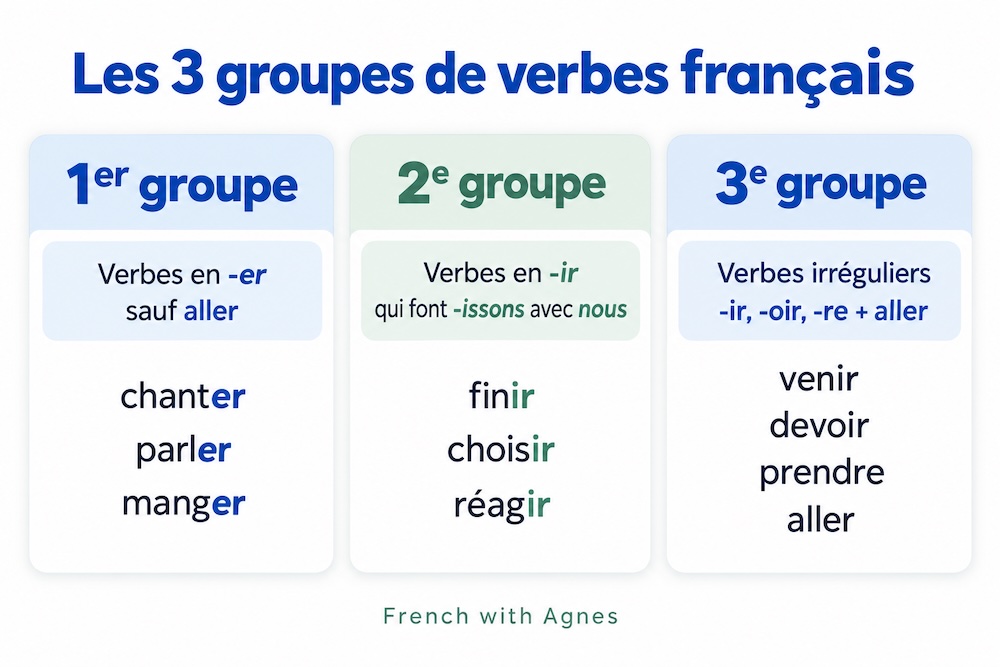
The first group contains verbs ending in -er, apart from aller. It is the largest and most regular verb group.
Reguler ER Verbs
The first group contains verbs ending in -er, apart from aller. It is the largest and most regular verb group. Examples include chanter (to sing), parler (to speak), aimer (to like or love) and s’habiller (to get dressed).
Remove -er from the infinitive and add the endings -e, -es, -e, -ons, -ez, -ent.
| PARLER | AIMER |
S’HABILLER |
|
|
Je / J’ |
parle | aime | m’habille |
|
Tu |
parles | aimes |
t’habilles |
|
Il/Elle/On |
parle | aime |
s’habille |
|
Nous |
parlons | aimons |
nous habillons |
|
Vous |
parlez | aimez |
vous habillez |
| Ils/Elles | aiment | parlent |
s’habillent |
Spelling Changes in Common ER Verbs
The first group is the easiest one to conjugate. However, bear in mind there are just a few exceptions to the rules.
-
French Verbs with -CER
You need to add a cedilla (ç) to the -c of the first person plural
AVANCER = to move forward
COMMENCER = to begin
ex : J’avance / Tu avances / Il-Elle-On avance /Nous avançons / Vous avancez / Ils-Elles avancent
-
Verbs with -GER
Here, we add an -e of the first person plural.
MANGER = to eat
VOYAGER = to travel
ex : Je mange / Tu manges / Il-Elle-On mange /Nous mangeons / Vous mangez / Ils-Elles mangent
-
Verbs with -YER
The -y will change before the mute -i. The verbs with -AYER also have 2 forms.
PAYER = to pay
ex1 : Je paye/ Tu payes / Il-Elle-On paye /Nous payons / Vous payez / Ils-Elles payent
ex2 : Je paie / Tu paies / Il-Elle-On paie / Nous payons / Vous payez / Ils-Elles paient
-
Verbs with -ELER/ETER
They take two -l ou two -t before a mute -e.
APPELER = to call
ex : J’appelle / Tu appelles / Il-Elle-On appelle /Nous appelons / Vous appelez / Ils-Elles appellent
If you would like a reliable reference to support your conjugation practice, explore this guide to the best French grammar books for all levels.
4. Regular IR Verbs in the Second Group
Then, the 2nd group has all the verbs ending with -issons at the “nous” form.
- ACCOMPLIR > nous accomplissons = we accomplish
- CHOISIR > nous choisissons = we choose
- FINIR > nous finissons = we finish
- REAGIR > nous réagissons = we react
Verbs end with : -is, -is, -it, -issons, -issez, -issent
| CHOISIR | FINIR | REAGIR | |
|
Je / J’ |
choisis | finis | réagis |
|
Tu |
choisis | finis |
réagis |
|
Il/Elle/On |
choisit | finit |
réagit |
|
Nous |
choisissons | finissons |
réagissons |
|
Vous |
choisissez | finissez |
réagissez |
| Ils/Elles | choisissent | finissent |
réagissent |
Important : Not all the verbs ending with –IR are in the 2nd group. For example, venir will become nous viendrons (not with –issons). Therefore, it is part of the 3rd group.
5. Third Group and Irregular Verbs
The third group includes aller, many verbs ending in -ir, -oir and -re, and other irregular verbs. There is no single ending pattern for the whole group. Learn the most useful verbs in complete sentences and notice how their stems change between singular and plural forms.
verb ALLER
- ALLER = to go
| Subject | Aller |
| je / j’ | je vais |
| tu | tu vas |
| il / elle / on | il va |
| nous | nous allons |
| vous | vous allez |
| ils / elles | ils vont |
verbs ending with –IR (but not ending with –issons at the 1st person plural)
Ouvrir and offrir belong to the third group, but their present tense endings resemble those of regular -er verbs.
- OFFRIR = to offer
- OUVRIR = to open
| Subject | Ouvrir | Offrir |
| je / j’ | j’ouvre | j’offre |
| tu | tu ouvres | tu offres |
| il / elle / on | il ouvre | il offre |
| nous | nous ouvrons | nous offrons |
| vous | vous ouvrez | vous offrez |
| ils / elles | ils ouvrent | ils offrent |
verbs ending with –RE
Vendre follows the common -re pattern, while prendre and apprendre change their stem in the plural forms.
- PRENDRE = to take
- VENDRE = to sell
- APPRENDRE = to learn
- ATTENDRE = to wait
| Subject | Prendre | Vendre | Apprendre |
| je / j’ | je prends | je vends | j’apprends |
| tu | tu prends | tu vends | tu apprends |
| il / elle / on | il prend | il vend | il apprend |
| nous | nous prenons | nous vendons | nous apprenons |
| vous | vous prenez | vous vendez | vous apprenez |
| ils / elles | ils prennent | ils vendent | ils apprennent |
verbs ending with –OIR
- DEVOIR = must / to have to
- POUVOIR = to be able to
- SAVOIR = to know
- VOULOIR = to want
| POUVOIR | RECEVOIR | SAVOIR | |
|
Je / J’ |
peux | reçois | sais |
|
Tu |
peux | reçois |
sais |
|
Il/Elle/On |
peut | reçoit | sait |
|
Nous |
pouvons | recevons |
savons |
|
Vous |
pouvez | recevez | savez |
| Ils/Elles | peuvent | reçoivent | savent |
Would you like to use these verbs more confidently in real conversations?
In personalised lessons, we can practise the present tense through situations connected to your daily life, work and interests.
5. Present Tense Pronunciation Tips
French present tense endings are often easier to recognise in writing than in speech. The endings -e, -es and -ent are normally silent in regular -er verbs, so je parle, tu parles, il parle and ils parlent have the same verb sound.
The nous and vous endings are easier to hear: nous parlons and vous parlez. When an ils or elles subject is followed by a verb beginning with a vowel sound, a liaison may also occur: ils ont and elles aiment.
For more guidance, read these tips to improve your French pronunciation. Repeat each verb with its subject pronoun so that you learn the sound and the form together.
6. Three Ways to Remember French Present Tense Conjugations
Learn the Verbs You Use Most
Start with être, avoir, aller, faire, pouvoir, vouloir and verbs connected to your daily routine. Learning useful verbs first will help you build sentences more quickly.
Learn Each Verb with Its Pronoun
Say je vais rather than memorising only vais. Learning the verb with its subject pronoun will help you recall the correct form more naturally when you speak. If you need to review French subject and object pronouns, read The Pronouns in French: A Simple Guide.
Practise with Personal Sentences
Use each verb in a sentence related to your life: Je travaille à la maison, Nous choisissons un restaurant or Je prends le train à huit heures. Personal examples are easier to remember than isolated lists.
Ready to Make Further Progress in French?
I’d love to help you build your confidence and make further progress with personalized French lessons.
Comments are closed.